Somatic symptoms are highly prevalent and constitute a major public health concern. Sociodemographic factors associated with these symptoms, particularly among cisgender men, transgender men, and gender-diverse individuals, remain insufficiently explored in Switzerland. We analyzed data from the Swiss Health Survey 2022, a nationally representative cross-sectional study.
The sample included cisgender men, transgender men (i.e., assigned female at birth and identifying as men), and gender-diverse assigned male at birth (AMAB) individuals (i.e., assigned male at birth and currently identifying as nonbinary or another gender). Somatic symptom load was assessed by combining common somatic complaints including gastrointestinal issues, pain, palpitations, and weakness and subsequently dichotomized into lower vs. severe symptom burden. Sleep problems were measured by difficulties falling asleep, restless sleep, repeated awakenings, and early-morning awakening and categorized into no/few vs. moderate/severe sleep problems for subsequent analyses.
Energy and vitality were assessed using the Short Form 36 Health Survey (SF-36) Vitality (VT) subscale, capturing fatigue, tiredness, and overall vitality over the past four weeks and were analyzed as a continuous outcome. Data were analyzed using IBM SPSS Statistics©. Two binary logistic regression analyses were conducted for symptom load and sleep problems, respectively, and one linear regression analysis was performed for vitality as a continuous outcome.
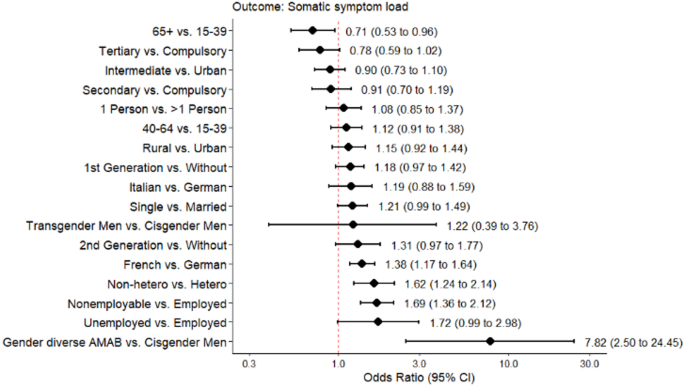
To account for the complex survey design, all analyses incorporated survey weights and canton as the stratification variable using design-based (complex samples) procedures. The analytical sample comprised 8,699 individuals (unweighted), representing an estimated population of 3,505,801 after applying survey weights. Compared with cisgender men, gender-diverse AMAB individuals showed higher odds of severe somatic symptom load (OR = 7.82, 95% CI [2.50; 24.45]), whereas transgender men did not differ significantly on this outcome (OR = 1.22, 95% CI [0.39; 3.76]).
Both groups showed higher odds of sleep problems (transgender men: OR = 4.66, 95% CI [1.64; 13.25]; gender-diverse AMAB individuals: OR = 3.87, 95% CI [1.21; 12.30]) and lower vitality scores (B=-13.70, 95% CI [-20.04; -7.35]; B=-14.70, 95% CI [-25.93; -3.47], respectively). These estimates rest on small unweighted subgroups (35 transgender men, 16 gender-diverse AMAB individuals), are correspondingly imprecise, and should be read as exploratory. Additional factors associated with poorer outcomes included non-heterosexual orientation, nonemployable status, migration background, and residence in French- or Italian-speaking regions.
Older age (65 + years) was associated with lower odds of severe somatic symptom load (OR = 0.71, 95% CI [0.53; 0.96]) but higher odds of sleep problems (OR = 1.35, 95% CI [1.08; 1.70]) and higher vitality scores (B = 8.89, 95% CI [6.83; 10.95]). Factors associated with somatic symptom load, sleep problems, and vitality showed both shared and outcome-specific patterns. Gender identity was associated with poorer sleep and lower vitality in transgender men and gender-diverse AMAB individuals compared with cisgender men, whereas higher somatic symptom load was found only in gender-diverse AMAB individuals.
Extract — continue reading at the source.


