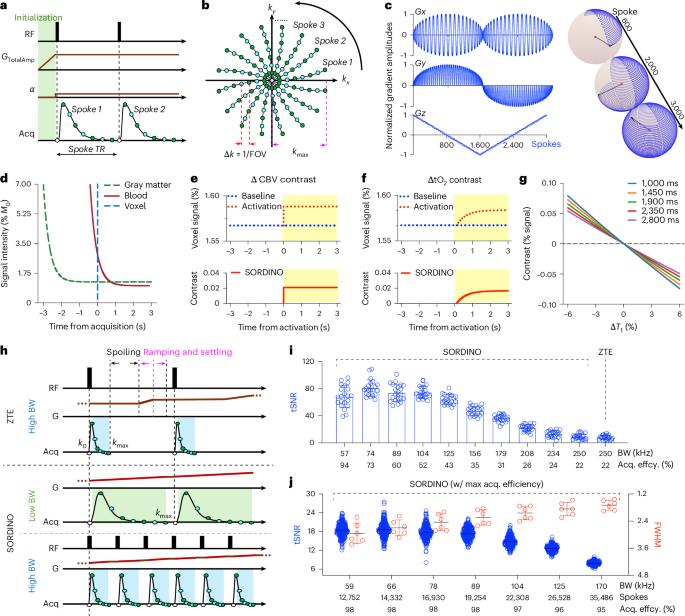
Blood-oxygenation-level-dependent (BOLD) functional magnetic resonance imaging (fMRI) has advanced brain mapping across species. This widely used technique, however, faces challenges such as acoustic noise, electromagnetic interference, motion artifacts, magnetic-field inhomogeneity and limitations in sensitivity and specificity. Here we introduce Steady-state On-the-Ramp Detection of INduction-decay with Oversampling (SORDINO), an improved zero echo time (ZTE)-based fMRI technique that maintains ultra-low slew rate and acquires data exclusively during gradient direction changes.
At 9.4 T, SORDINO outperforms conventional gradient-recalled-echo-based echo-planar imaging and ZTE in metrics crucial for fMRI while being silent, sensitive, specific and resistant to motion and susceptibility artifacts. We showcase SORDINO’s superior compatibility with multimodal experiments and reveal T1-based contrast mechanisms distinct from BOLD that are expected to generalize across ZTE-based fMRI techniques. We further demonstrate SORDINO brain-wide activity and functional connectivity mapping in awake, behaving mice, overcoming stress-related, motion-related and sensitivity-related limitations that remain common barriers in current animal fMRI studies.
Gradient-recalled echo (GRE)-based echo-planar imaging (EPI) has been the gold standard in fMRI because of its ability to rapidly acquire effective transverse relaxation time (T2*)-weighted BOLD functional contrast throughout the brain1,2. However, EPI remains susceptible to acoustic noise, electromagnetic interference, motion and magnetic field inhomogeneity, while offering limited sensitivity and poor spatial specificity owing to its bias toward venous vasculature. These limitations are particularly problematic for rodent fMRI3,4,5 because acoustic noise often forces the use of anesthesia6,7,8, compromising brain function and limiting translational relevance to human fMRI.
In addition, awake imaging requires extensive habituation to mitigate stress and motion9,10,11,12,13,14,15,16, and susceptibility artifacts are amplified at the high magnetic field strengths (>7 T) commonly used in rodent studies5,6,7. These methods acquire center-out free-induction-decay (FID) signals under steady gradients and are inherently less susceptible to acoustic noise, electromagnetic interference and common EPI-related artifacts17,18. In the preclinical setting, the utility of ZTE variants for functional imaging was first demonstrated by MB-SWIFT in 2017, showing inflow-dependent fMRI responses following deep brain stimulation20.
Building on this work, hard-pulse-based radial ZTE was first applied to fMRI with iron oxide nanoparticles in 2020 (ref. 21), followed by the demonstration of intrinsic ZTE-fMRI responses without contrast agents through minimized gradient ramp and settling times and the modeling of multiple potential contrast origins in 2021 (ref. 22) (see detailed implementation in ref. 23). In 2023, we proposed acquiring data during gradient ramping for ZTE-fMRI24. These studies established the feasibility of hard-pulse ZTE for fMRI without the frequency-modulated excitation used in MB-SWIFT, while preserving the core advantages of zero-acquisition-delay imaging.
Although ZTE-based techniques have been adapted for fMRI applications20,21,22,23,24,25,26,27,28,29, their sensitivity relative to GRE-EPI has not been systematically demonstrated at commonly used magnetic field strengths, limiting broader adoption because reduced sensitivity requires additional experimental repetitions or larger sample sizes. Furthermore, as these methods are insensitive to BOLD contrast, the mechanisms underlying their functional signal changes remain incompletely understood. Importantly, there remains limited demonstration of compelling applications, particularly in awake and behaving mouse models, whereby these methods would offer distinct advantages over conventional approaches.
Extract — continue reading at the source.


