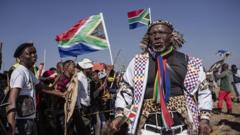
Thousands of anti-migrant protesters march in South Africa amid heavy police presence dinated protests have taken place across the country with a heavy security presence in most citiesByNomsa Maseko, BBC Africa, Reporting fromDurban, Khanyisile Ngcobo, Reporting fromJohannesburg, Farouk Chothia and Hafsa KhalilPublished29 June 2026Updated 30 June 2026Thousands of people have marched in South Africa's main cities to demand that all undocumented migrants leave the country. Police officers - backed by private security guards - have been deployed because of fears that protests could turn violent. Anti-migrant groups had set Tuesday as the deadline for undocumented migrants to leave.
Many foreigners have already fled to escape violence and intimidation. South African police say 25,000 have been repatriated so far. Most are from other African countries.One undocumented Malawian told the BBC he was "happy to be going back" but "heartbroken" to be leaving behind four young children.'They came with machetes' - deadline looms for migrants to leave South AfricaPublished17 JuneThe Ministry of Police said the protests had largely been peaceful across the country, with isolated incidents of looting.
However Police Minister Firoz Cachalia confirmed that the army was deployed "on a contingency basis" in parts of Johannesburg as well as Durban. Police also confirmed the arrest of three people in Hillbrow, a suburb in Johannesburg with a high migrant population, after two people were injured during protests.According to police, the trio "opened fire at protesters who were passing through the street" and the marchers retaliated by "torching the suspects' vehicle". Among the injured was a 17-year-old.Some protesters threw bricks, breaking the windows of some homes in Yeoville, another suburb where many African migrants live.Shops in the city centre were closed, while police visibility is high on major streets.In a neighbourhood in Germiston, about 15km (nine miles) from Johannesburg, demonstrators went to homes, evicting residents they suspected were foreign nationals and handing them over to police officers, insisting they check their documentation, local media report.Police said they had arrested five people for the alleged looting of a foreign-owned shop in Johannesburg's biggest township, Soweto.
About 10 people were also arrested for looting in KwaZulu-Natal province, while a woman was arrested for assaulting a police officer and a man for "intimidation" following reports of a foreign national being beaten up, police said. Businesses in central Durban, the main city in the province, were also shut.Protesters handed over a memorandum listing their demands to government officials in Durban and Johannesburg. The leader of anti-migrant group March and March, Jacinta Ngobese-Zuma, said they would protest every Thursday for the next six months to force the government to "get rid of" undocumented migrants who were still in South Africa.A demonstrator - who is part of another anti-migrant group, Operation Dudula - told the BBC they would "push the police" to arrest foreigners who are not legally in the country.President Cyril Ramaphosa met some of the protest leaders on the eve of Tuesday's marches to defuse tensions.
He has repeatedly warned demonstrators to act peacefully, while also accepting the need for immigration reforms. . Anti-migrant protesters march in South Africa"Some foreign nationals who live in South Africa are here lawfully," he reminded citizens in his weekly newsletter, external."They work, study, raise families, invest in our economy and contribute positively to our society. They too are entitled to the protection of our laws and our Constitution."The right to protest and freedom of expression does not allow people to threaten or intimidate others, or to engage in acts of vandalism or violence," he wrote.There are more than three million documented foreign nationals in South Africa, according to official figures.The statistics do not record the many more migrants believed to be in the country without papers - a bone of contention for the protesters.Police said that about 50,000 migrants had been arrested since January for being in the country illegally.Many African migrants moved to South Africa around the time white-minority rule ended in 1994, hoping for a better life.But with South Africa facing an unemployment rate of more than 30%, anti-migrant sentiments have risen.Nigeria flew out 269 of its citizens on the eve of the protests, bringing to around 600 the number evacuated so far to the West African nation.
More evacuations are expected to take place in the coming days.Ghana, Malawi, Mozambique and Zimbabwe have also been repatriating their citizens by plane or bus. Ahead of the deadline, thousands of migrants have been awaiting processing in temporary camps for several weeks out of fear for their safety.Image gallerySkip image gallery e had said no traditional weapons would not be allowed - but in the end they did not confiscate them from those marching arch in Durban was relatively peaceful and many businesses in the city shut for the day hannesburg there have been pockets of trouble in areas where migrants live arch and March movement says there will be protests every Thursday for the next six months to force the government to "get rid of" undocumented migrants1 of 4Previous imageNext imageSlide 1 of 4, Protesters in Durban, some holding traditional weapons, Police had said no traditional weapons would not be allowed - but in the end they did not confiscate them from those marchingEnd of image galleryIn Durban, which h
Extract — continue reading at the source.