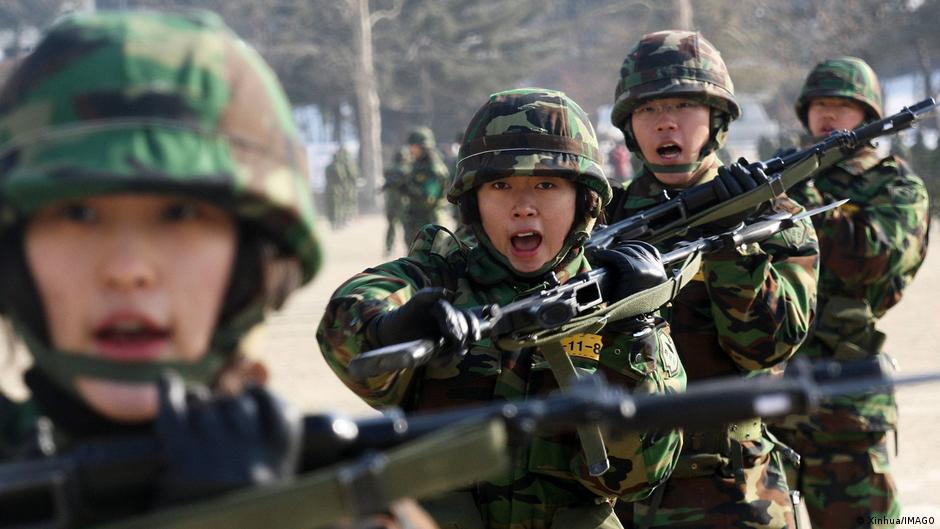
Nearly 60% of South Koreans are now in favor of young women serving mandatory military service alongside their male counterparts, according to a recent survey, representing a significant shift in the long-held taboo against women being obliged to defend the nation. Thousands of women already serve in the South Korean armed forces on a voluntary basis, but the debate over mandatory service has always been delicate. Now, for a series of reasons that include a falling birth rate and shrinking number of recruits as well as an insistence that social equality means that women should also serve, the issue has re-emerged ahead of a reform of the national defense plan scheduled to be released this autumn.
Yet, there are still those who insist that women should be kept away from the front lines and, instead, that South Korea should invest more in drones and other advanced technologies. "South Korea's male-centered conscription system has long been closely connected to traditional gender roles," said Hyobin Lee, a professor at Sogang University in Seoul. "Men were generally expected to protect the country and the family and to fight in wartime, while women were expected to take primary responsibility for childbirth, childcare and the household," she told DW.
A second factor is the intensifying debate about gender equality, a debate in large part driven by young men, she said. "South Korean men generally perform their military service in their early 20s, which interrupts their education, employment or early career development," Lee said. "At the same time, gender equality has become an increasingly important social value, and women's opportunities in education and employment have expanded." "As a result, some younger men ask a very simple question: If society expects equality in rights and opportunities, why does one of the country's most significant civic obligations – military service – still fall only on men?" To view this video please enable JavaScript, and consider upgrading to a web browser that supports HTML5 video Another contributing factor is the change in the nature of the military itself, with a shift away from physically demanding combat roles that were perceived as being more suited to men and the emergence of a national defense more heavily reliant on technology.
This includes unmanned systems, cyber capabilities, information and communications technology and others that do not require physical strength. According to the study, carried out by the Reform Institute, the policy research arm of the conservative-leaning Reform Party, and published on August 20, almost 60% of the respondents were in favor of changing the law to require women to undergo national service. Just 34% were opposed to the idea.
Nearly 65% of men were in favor – a figure that rose to 71.7% among men in their 20s and 30s – with 54.5% of women across all age groups similarly supportive. At present, all able-bodied males are required to complete a minimum of 18 months and up to 21 months of service and can be called back into service in the event of a national emergency, such as war breaking out on the tense Korean Peninsula. The latest figures highlight, however, the personnel shortages that South Korea's armed forces are experiencing.
According to the Defense Ministry, around 332,000 men were eligible to perform mandatory military service in 2019, but that had fallen to 257,000 men in 2022 and is forecast to shrink to just 120,000 men in 2043. And while she is strongly in favor of equality throughout South Korean society, Professor Lee fears that obliging women to serve the same military terms as men may turn out to be a negative because so many other elements in society still lag. "Women in South Korea still bear a much greater share of the responsibilities associated with pregnancy, childbirth and childcare," she underlined.
Extract — continue reading at the source.