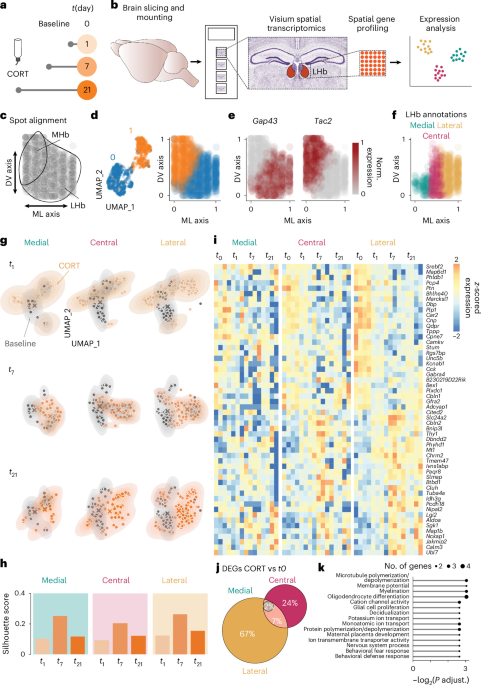
Chronic stress has lasting adverse consequences that can lead, over time, to depression, yet the optimal timeframe for effective therapies remains unclear. The lateral habenula (LHb) has been implicated in stress-related behavioral repercussions, but the precise timing of its contribution is not understood. Here, using spatial transcriptomics, we generated a spatially resolved molecular atlas of the LHb of male mice, revealing a topographically organized and temporally defined remodeling of gene expression after chronic stress.
Longitudinal in vivo two-photon calcium imaging of individual LHb neurons revealed progressively heightened excitatory responses to aversive stimuli. These neuronal adaptations mirrored both the progression of transcriptional changes and the emergence of depression-related behavioral phenotypes and were reversed by the antidepressant ketamine. Moreover, chemogenetically limiting LHb neuronal activity or administering ketamine at the onset of these changes exerted antidepressant effects.
These findings link spatiotemporal signatures of LHb neuronal ensembles and genetic landscape with the onset of stress-induced depression-related states. Depression is characterized by alternating episodes of persistent low mood and diminished coping capacity, interspersed with periods of apparent wellness1. Although antidepressant treatments are available, they are effective in only a fraction of individuals, partly due to challenges in timely diagnosis and treatment initiation2,3,4,5.
This requires an understanding of the trajectories of the depressive state and their underlying mechanisms to ultimately tailor therapies within defined temporal windows6,7,8. In humans, repeated exposure to stressful events and the consequent prolonged elevation of stress mediators (for example, cortisol) can lead to the emergence of depressive episodes9,10,11. Similarly, in rodents, paradigms that chronically elevate stress hormones, including protracted restraint, social defeat or administration of corticosterone (CORT)8,12,13, recapitulate core behavioral features of human depression13,14,15.
However, most research has focused on the consequences of prolonged stress exposure only at a late timepoint. This leaves a gap in understanding the temporal trajectories delineating the onset of depression-related behaviors (defined here as the onset of stress susceptibility) and their underlying mechanisms during chronic stress. The LHb is a primary target of stressful events, with neurons in this structure activated by a wide range of stressors across various species14,16,17,18,19,20.
In rodents, chronic stress perturbs gene expression, alters synaptic neurotransmission and increases neuronal activity in the LHb, leading to behavioral signatures reminiscent of human depression14,21,22,23. Notably, once depression-related behaviors are established, various antidepressant treatments can normalize them by restoring physiological neuronal parameters in the LHb15,24,25,26. However, the temporal relationship between the onset of LHb adaptations and the emergence of depressive phenotypes remains poorly understood.
Extract — continue reading at the source.