sözaltı news World
World
EN AZ
'Speed, money and compassion' - lessons from an Ebola survivor and other experts

'Speed, money and compassion' - lessons from an Ebola survivor and other experts

bbc.com 23.05.2026 03:07 20 baxış
Those caught up in West Africa's Ebola outbreak a decade ago on how best to tackle the current epidemic.

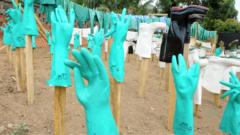
'Speed, money and compassion' - lessons from an Ebola survivor and other experts Thomas MukhwanaAfrica correspondentAFP via ImagesWest Africa experienced the world's worst and most complex Ebola epidemic more than a decade ago"I saw the burial team taking eight of them," recalls Ebola survivor Patrick Faley. "They put them into a bag and carried them to the burial. I made new friends although they ended up dying.

I was the only person that was left there."This week's scenes from the Democratic Republic of Congo, where medics are scrambling to respond to an outbreak of Ebola, have brought back haunting memories for those who have lived through similar crises.A decade ago Faley found himself on the front line of a similar situation in West Africa - the worst recorded outbreak of the disease, which killed more than 11,000 people in two years mostly in Guinea, Liberia and Sierra Leone.For Faley, the memories of what he lived through, including the death of so many of his friends, raise questions about lessons that can be learned for how to handle the latest outbreak in eastern DR Congo in which the World Health Organization (WHO) says more than 170 people have died.His story is a reminder of the horrors the virus can cause.Faley was recruited as a community volunteer by Liberia's Ministry of Health to spread awareness about Ebola. He went from village to village to explain how the virus was spread by contact with bodily fluids and encourage people to stop things like greeting one another by shaking hands.It also involved dispelling rumours and explaining why traditional mourning practices - such as washing the bodies of the deceased - had to be banned.He worked within communities near his home in the north of the country - and says it was attending the funeral of a colleague who had died of the disease that changed his life as he himself forgot the advice."You have to shake hands; you have to hug people," he tells the BBC. "Forgetting to know that we have a crisis, an emergency crisis in our country."Three days after the funeral, he fell sick with Ebola, finding himself turning from healthcare worker to patient and ending up in the capital, Monrovia, in an overcrowded ward, filled with the bodies of those who had died."We sat in the ambulance," he remembers, "and people were just dying at the front of the hospital".Faley recovered from the infection, but his wife and son later caught the virus as well.

His wife got better and made it home. Tragically, their four-year-old son Momo did not survive.The lessons from the West African outbreak a decade ago are helping to shape the response this week to the new surge of cases in DR Congo, with funerals banned for those suspected to have been infected.This has sparked tension in some communities, with a crowd angrily setting fire to part of a hospital on Thursday near the epicentre in the city of Bunia after being told a body would not be released for burial.But it is essential to learn lessons from the past and to ensure affected communities are on board, says Dr Patrick Otim, WHO's area manager for Africa."One of the biggest lessons from the West Africa outbreak and previous Ebola outbreaks in DRC is that speed matters," he says."Early delays in detecting cases, isolating patients and engaging communities can allow transmission chains to expand very quickly."Another point, he explains, is that outbreaks cannot be controlled through medical interventions alone."Community trust is essential. Safe and dignified burials, local leadership engagement and clear communication are just as important as laboratories and treatment centres."This outbreak is the 17th to have emerged in DR Congo since Ebola was discovered half a century ago in 1976.It is only the third worldwide of the rare Bundibugyo species of Ebola, which emerges less often than the more common one, known as Zaire.And while the West African outbreak was curbed after two years, with vaccines, experts have warned Bundibugyo has no vaccine or known treatment."Just because a vaccine works against one particular type of a virus doesn't mean it's going to work against another one," Professor Thomas Geisbert tells me over the phone from his laboratory at the University of Texas Medical Branch in the US.Geisbet is a leading expert on Ebola, and one of two researchers who invented the first known vaccine for the virus, known as Ervebo."That remains currently the only vaccine available in the global stockpile," he says.Getty ImagesVaccines, which are expensive to develop, were key to ending the West Africa Ebola epidemicBundibugyo's genetic sequence is different from the Zaire species by about 30%, meaning the existing vaccines are ineffective against it.The WHO says it could take up to nine months to find an effective vaccine - although scientists at Oxford University in the UK have just announced that they are developing one that could be ready for clinical trials within two to three months.This is something on which Prof Geisbet has been working.He tells the BBC how he created a similar single-injection vaccine targeting Bundibugyo, using the blueprint of the original Ervebo.Tests on monkeys showed 83% protection from Bundibugyo, but it has yet to progress to human trials.Geisbet warns that getting a vaccine from the laboratory to rollout, with trials and manufacturing, can cost more than $1bn (£745m).It is an investment with "a whole bunch of zeros behind the dollars", he says - and one pharmaceutical companies have so far not seen as being profitable.For Wallace Bulimo, biochemistry professor at Kenya's University of Nairobi, events in DR Congo underscore the need for more investment."Why is it that we have not actually done a lot of work on this virus?" he asks.

"And yet we knew it was there."It was first discovered in 2007, so we should have actually never ignored it."Faley warns those currently on the front line in eastern DR Congo that there i

Extract — continue reading at the source.

Read full story