Posttraumatic syringomyelia is a recognized complication of spinal cord injury, often associated with progressive neurologic decline and surgical management. Its natural history remains incompletely understood, and spontaneous resolution is rare. We performed a literature review identifying six previously reported cases of spontaneous radiologic resolution of posttraumatic syringomyelia and report a 69-year-old patient with posttraumatic cervicothoracic syringomyelia showing a dynamic course characterized by initial mild enlargement followed by spontaneous radiologic resolution over 13 years of follow-up.
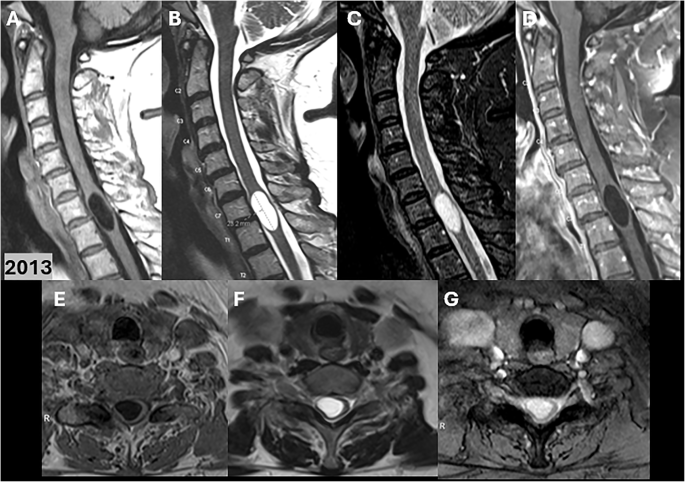
Initial MR imaging in 2013 demonstrated a focal expansile syrinx at C7–T1 without enhancement, cerebrospinal fluid flow obstruction, or Chiari malformation. At presentation, the patient reported occipital headaches, dizziness, and subjective upper extremity weakness. Serial MR imaging demonstrated mild interval enlargement in 2019, followed by progressive decrease in 2022 and 2024, and near-complete resolution in 2026, with a residual slit-like cavity and focal cord thinning.
Neurologic examinations remained normal throughout follow-up, and symptoms resolved. This case demonstrates a dynamic course of posttraumatic syringomyelia with spontaneous radiologic resolution and clinical stability in the absence of surgical intervention. These findings suggest that a subset of patients may follow a benign or reversible course, supporting close clinical and imaging follow-up in selected cases.
Posttraumatic syringomyelia (PTS) is a recognized complication of spinal cord injury, with a reported prevalence of approximately 4% [1]. It typically develops from months to years after the initial trauma and is characterized by a progressive clinical course that may include neuropathic pain, motor weakness, sensory deficits, autonomic dysfunction, and spasticity [2]. Not all patients are symptomatic at presentation, likely reflecting variability in syrinx size, location, and degree of cord compression [1].
Management is guided by clinical status and disease progression. Asymptomatic patients may be managed conservatively with close clinical observation and serial MR imaging, whereas those with progressive neurologic deficits are considered for surgical intervention [3]. Given the potential for neurologic decline and the uncertain natural history, surgical treatment is often advocated in selected patients [4].
However, long-term outcomes remain variable, with reported risks of treatment failure and symptom recurrence [5]. A systematic review of 43 observational studies including 1803 patients reported postoperative complications in approximately 26% of cases [6]. Interpretation of postoperative outcomes is further limited by the retrospective nature of available data and the delayed onset of disease, which may extend beyond typical 2–5-year follow-up periods and lead to underestimation of recurrence rates [7].
Extract — continue reading at the source.


