Ireland’s national soccer team is facing mounting calls to boycott its upcoming UEFA Nations League matches against Israel, as "Stop the Game" protests pile pressure on players and officials to abandon the fixtures. Ireland, which has frequently criticized Israel’s war in Gaza and formally recognized the state of Palestine in 2024, is due to face Israel, which has accused the Irish government of "extreme anti-Israel policies," twice in UEFA’s international competition for European national teams. The games are scheduled for September 27 on neutral territory in Debrecen, Hungary, where Israel will technically be the "home" team, and October 4 in Bačka Topola, Serbia, where Ireland will be the designated "home" side.
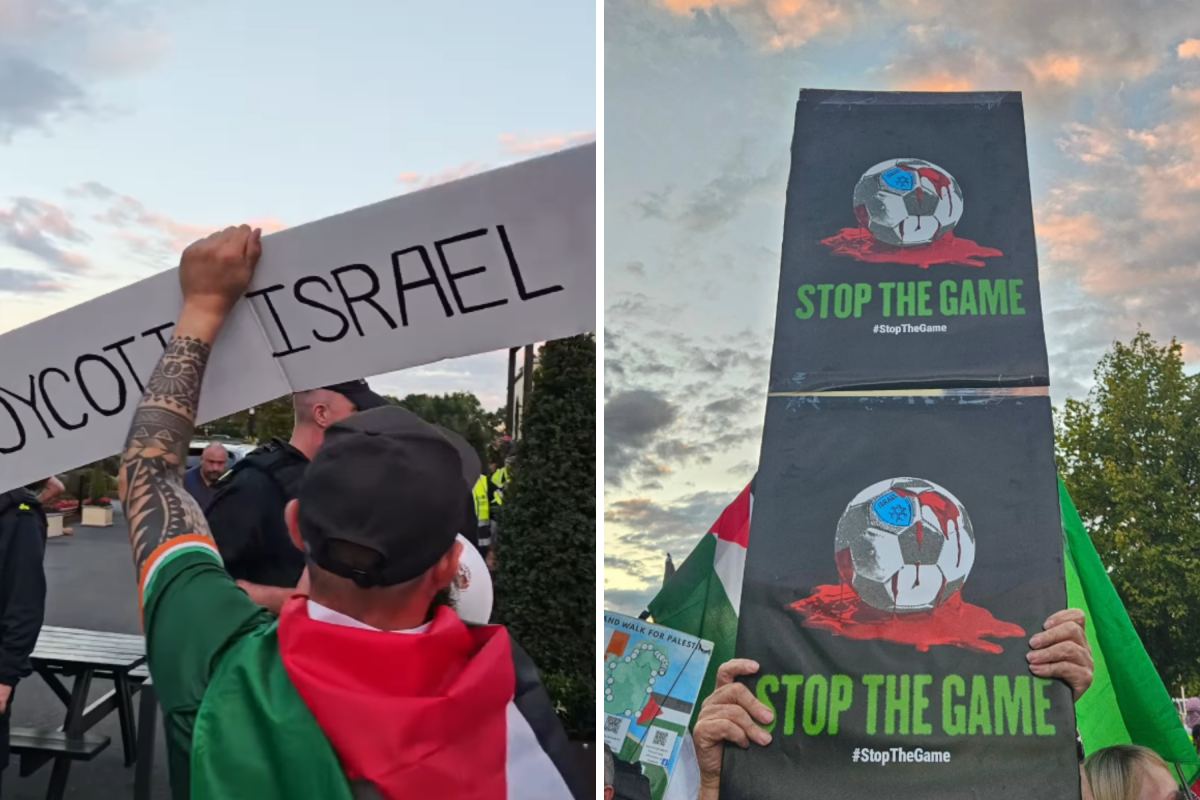
The Football Association of Ireland (FAI) has said it will not facilitate tickets for Irish supporters at either match, citing "operational challenges and safety and security concerns." A small allocation of Israeli supporters will be permitted to attend the September game. But, as the fixtures approach, pressure to boycott them has intensified this week, from athletes, former internationals and pro-Palestinian protesters. "Stop the Game" demonstrators wrapped in Palestinian flags on Monday gathered outside the CastleKnock Hotel, in Dublin, Ireland, where the team are staying.
Meanwhile, more than 160 athletes signed an open letter written by the Irish Sport for Palestine Group to the Republic of Ireland men’s national soccer team "urging them to act collectively with conscience & refuse to participate in their upcoming games against Israel." The campaigners, as well as Ireland’s coach Heimir Hallgrimsson himself, have accused Israel of carrying out genocide in Gaza with its response to the Hamas attack on Israel on October 7, 2023, but Hallgrimsson has defended the decision to play the games, saying: "We’re not playing with genocide, we’re playing against genocide." Israel has long denied its military campaign constitutes genocide, a position that has been supported by President Donald Trump's White House. In arguments before the International Court of Justice, where it faces a genocide case filed by South Africa, Israel said: "Israel is fighting Hamas terrorists, not the civilian population," and described the conflict as "a war of defense against Hamas -not against the Palestinian people." Hallgrimsson, who is from Iceland, made his comments about Ireland "playing against genocide" when he announced his squad at a press conference in Dublin on September 17. "Without going into individuals, none of us feel comfortable playing in these games but once we have decided to play them, we all stick together and play as one," he said.
"We’re not playing with genocide, we’re playing against genocide. We’re playing against Israel, we’re not playing with Israel." On Monday, Israel FA targeted Hallgrimsson in a post on X, saying: "We have contributed to the world and humanity in countless fields, earning an impressive number of Nobel Prizes along the way. Unfortunately, we have not yet found a cure for stupidity, ignorance and hypocrisy displayed by [Ireland’s] team coach.
We’re not playing with ignorance, hypocrisy and stupidity, We’re playing against the coach who embodies them." Sport 5, a major Israeli sports outlet, reported on Sunday that Israel FA Chairman Shino Zuaretz is considering making a complaint to UEFA about Hallgrimsson’s comments. It cited "association officials who remained in Israel" who said: "It is impossible for someone to say genocide against us and not respond to him." Israel FA told Newsweek it is waiting until after the two upcoming games to make a decision on whether it will go ahead with the complaint. Hallgrimsson has spoken out against Israel’s inclusion on the competition before—last October, he said: "I don't see a difference between FIFA and UEFA banning Russia (after the 2022 invasion of Ukraine) and not Israel.
I don’t see the difference." The FAI's Chief Executive David Courell said last week that he could see the "strength of sentiment (against Ireland playing the games) that exists," describing it as "tangible" during an interview with Ireland’s national public-service broadcaster RTÉ. "I believe the association has been put in a really difficult position," Courell said. "We are here because we were drawn out of a bowl for the qualification group, but also, it's been compounded by the association adopting a very strong position publicly and formally with UEFA." "So I hope people can recognize that we often remain silent on the topic, as Heimir has said, we're playing against Israel, not with them," he added.
Extract — continue reading at the source.