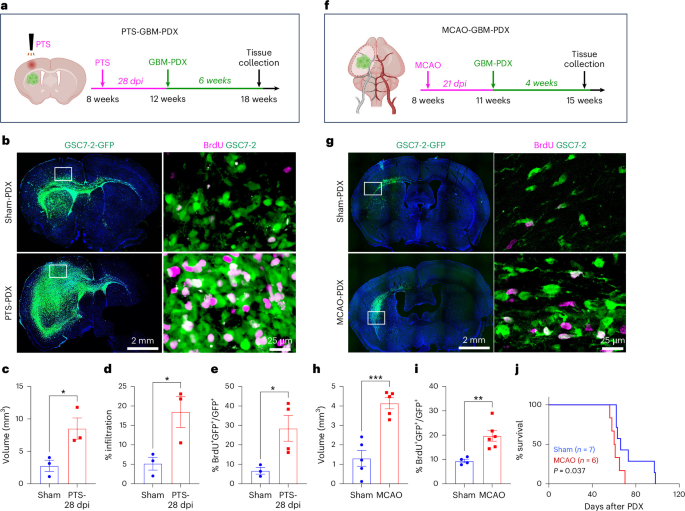
Epidemiological studies suggest that persons with a history of stroke are at increased risk of developing brain tumors, yet the mechanisms linking brain injury to glioma progression remain unclear. Here we show that stroke promotes tumor infiltration into injured brain regions in human and mouse glioma models, accompanied by reduced overall survival. Stroke induces remodeling of the tumor microenvironment, including the emergence of a distinct population of tumor-associated astrocytes (TAAs) with diminished Ca2+ activity at the invasive front and enrichment of tumor-associated microglia and macrophages (TAMs).
Restoring TAA Ca2+ signaling or TAM depletion suppresses stroke-induced glioma progression, identifying both populations as critical mediators of the injury response. Mechanistically, we identified SLC4A4 as a key regulator of Ca2+ activity in TAAs and CCL2-mediated TAM recruitment. Collectively, our findings establish stroke-induced remodeling of astrocytic Ca2+ signaling and TAMs as drivers of glioma progression and link brain injury to malignant disease.
This is a preview of subscription content, access via your institution Access Nature and 54 other Nature Portfolio journals Get Nature+, our best-value online-access subscription Receive 12 digital issues and online access to articles Prices may be subject to local taxes which are calculated during checkout scRNA-seq and spatial transcriptomic data generated in this study were deposited to the National Center for Biotechnology Information Gene Expression Omnibus under accession numbers GSE325816 and GSE325817, respectively. Previously published human datasets reanalyzed in this study are available under accession numbers GSE56267 (stroke), GSE209552 (traumatic brain injury), GSE149326 (MS) and GSE216281 (Parkinson disease) or from BrainSeq Phase 2 (schizophrenia) and ROSMAP (Alzheimer disease). Human GBM and LGG transcriptomic data were obtained from TCGA-GBM and TCGA-LGG cohorts of TCGA.
Human glioma scRNA-seq data were obtained from accession number GSE221536. All other data supporting the findings of this study are available from the corresponding author upon reasonable request. Source data are provided with this paper.
This study did not generate any original code or software. All analyses were performed using publicly available software packages as described in the Methods. Epidemiology and molecular pathology of glioma.
Neurol. 2, 494–503 (2006). Brain and other central nervous system tumor statistics, 2021. Clin. 71, 381–406 (2021).
Extract — continue reading at the source.


