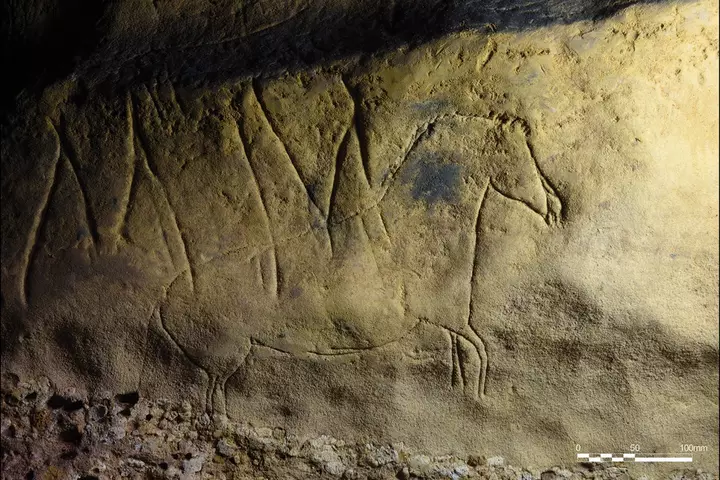
Josep Maria Vergès at the Catalan Institute of Human Paleoecology stumbled on the rock art at Cova de la Font Major, west of Barcelona, after a tourist group caught his attention. The visitors, wearing wetsuits, were taking part in an adventure activity and had emerged from a nearby opening that led into a small side gallery. Upon entering, he saw that the walls were covered with names and dates engraved by people who had passed through the gallery since 1957.
To examine them more closely, he removed his helmet and used the headlamp to illuminate the wall with raking light – a technique used to observe engravings because it creates shadows in the incised grooves. Then, as I turned toward the opposite wall and shone the light across its surface, the horse appeared and I realised it was executed in a Palaeolithic style.” He also immediately discovered that there were “many more engravings, many of them figurative representations of different animals”, he says. Representation of a bear with ears, shown in frontal perspective and with a slightly open mouth So far, 280 motifs have been discovered in the gallery, including 55 animal figures, making the cave one of the richest and most important archaeological finds along the Iberian coast between the Pyrenees and Gibraltar.
One challenge for archaeologists is that it is extremely difficult to date the engravings themselves, but human occupation in the cave has been dated to between 26,000 and 41,000 years ago and, based on the style, the art is likely to be over 19,000 years old. Team member Míriam Salas-Altès, also at the Catalan Institute of Human Paleoecology and Social Evolution, says one of the most outstanding figures is a hind, or adult female deer, depicted with its head lowered, its muzzle extending across a natural fissure. The crack appears to have been deliberately incorporated into the composition as the surface of a body of water from which the hind is drinking.
Among the non-figurative engravings, the team identified groups of lines arranged in twos, threes or fours and, in some cases, series of up to 40 straight, parallel lines, as well as Y-shaped signs and circular or semicircular shapes. While the exact age of the rock art is yet to be determined, it is “obvious” that it was made by a Palaeolithic culture, he says.
Extract — continue reading at the source.


