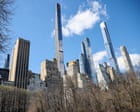
Steinway Tower, the world's skinniest skyscraper, in Manhattan. via Steinway Tower, the world's skinniest skyscraper, in Manhattan. via ImagesNew YorkSuper-rich complain but experts welcome Mamdani’s pied-à-terre taxNew York mayor’s policy set to generate revenue and address housing crisis despite outcry in some quarters Eric Berger in New York Sat 8 Aug 2026 14.00 CESTLast modified on Sat 8 Aug 2026 14.15 CESTShare New York City’s introduction of a pied-à-terre tax has provided fodder for Zohran Mamdani’s critics, who accuse the democratic socialist mayor of attacking the rich – even as others welcome it as a much-needed effort to tax the wealthy in a city known for its yawning inequality and cost-of-living crisis.The tax, aimed at closing the city’s budget gap, covers people who own but do not live full-time in a house worth more than $5m or a condominium or cooperative unit worth at least $1m.The city recently sent letters to 17,000 addresses suspected to be second homes and published a tax roll of about 960,000 owners who could be subject to the surcharge. The list, which the city stated was intended to help people find out if they could be liable, also contained the properties’ addresses and market values.Some New Yorkers were upset that they received notice of their potential tax liability even though the particular property is their primary residence. Others saw the list as an invasion of privacy and as Mamdani again trying to shame the ultra-rich.But some public policy experts see the tax as an effective, equitable way for the local government to generate additional revenue and perhaps create more affordable housing.
Nor do they expect the initial response to have lasting negative consequences for the city, as some of its – often wealthy – critics claim.“It places a tax on high earners, people with a lot of resources who can contribute more to the economy,” said Emily Eisner, executive director and chief economist at the Fiscal Policy Institute, a left-leaning thinktank.Eisner added: “I don’t think a lot of the typical concerns about migration are concerns when it comes to the pied-à-terre tax. I’m not concerned about dampening real estate markets … The largest concern is a matter of implementation and making sure that the city is able to appropriately assess many of these properties.”While middle- and lower-income Americans have had an increasingly difficult time in recent years purchasing homes and affording groceries, it’s become particularly hard in New York.More than a quarter of the city’s residents lived in poverty in 2024, which was twice the national average, according to a report from Columbia University and Robin Hood, an anti-poverty group. And only 33% of residents own a home or apartment, the lowest rate among US cities with 500,000 people or more, and half the national average, according to the Regional Planning Association, an urban planning group.Cities such as Paris, Singapore and Vancouver already have pied-à-terre taxes.
In theory, that makes it easier for people who want to live in the city to buy property.In April, Mamdani and the state governor, Kathy Hochul, announced the tax and said it would generate $500m in annual revenue. Mamdani also filmed a video outside a $238m penthouse owned by the billionaire hedge fund manager Ken Griffin.The tax is “specifically designed for the richest of the rich, those who store their wealth in New York City real estate but don’t actually live here”, he said in the clip, which received 53m views on X. He threatened to expand his business in Miami.But for the less wealthy, it can be difficult to succeed in New York because there is a shortage of affordable housing.
Mamdani has focused on the issue during his campaign and first year in office.“In the context of the city doing everything it can to get housing construction happening, the idea that we would be having empty units is hard to justify,” said James DeFilippis, a professor of planning and public policy at Rutgers University. Sales of Manhattan properties in the $10m to $20m range increased 38.6% in the second quarter as compared with the same period last year, according to the real estate broker Compass.Still, Mamdani may have suffered a political setback because of how the city informed the public about their potential tax liability. The New York Post, a conservative daily tabloid that frequently and vociferously attacks the mayor, recently ran a front cover featuring the
Extract — continue reading at the source.