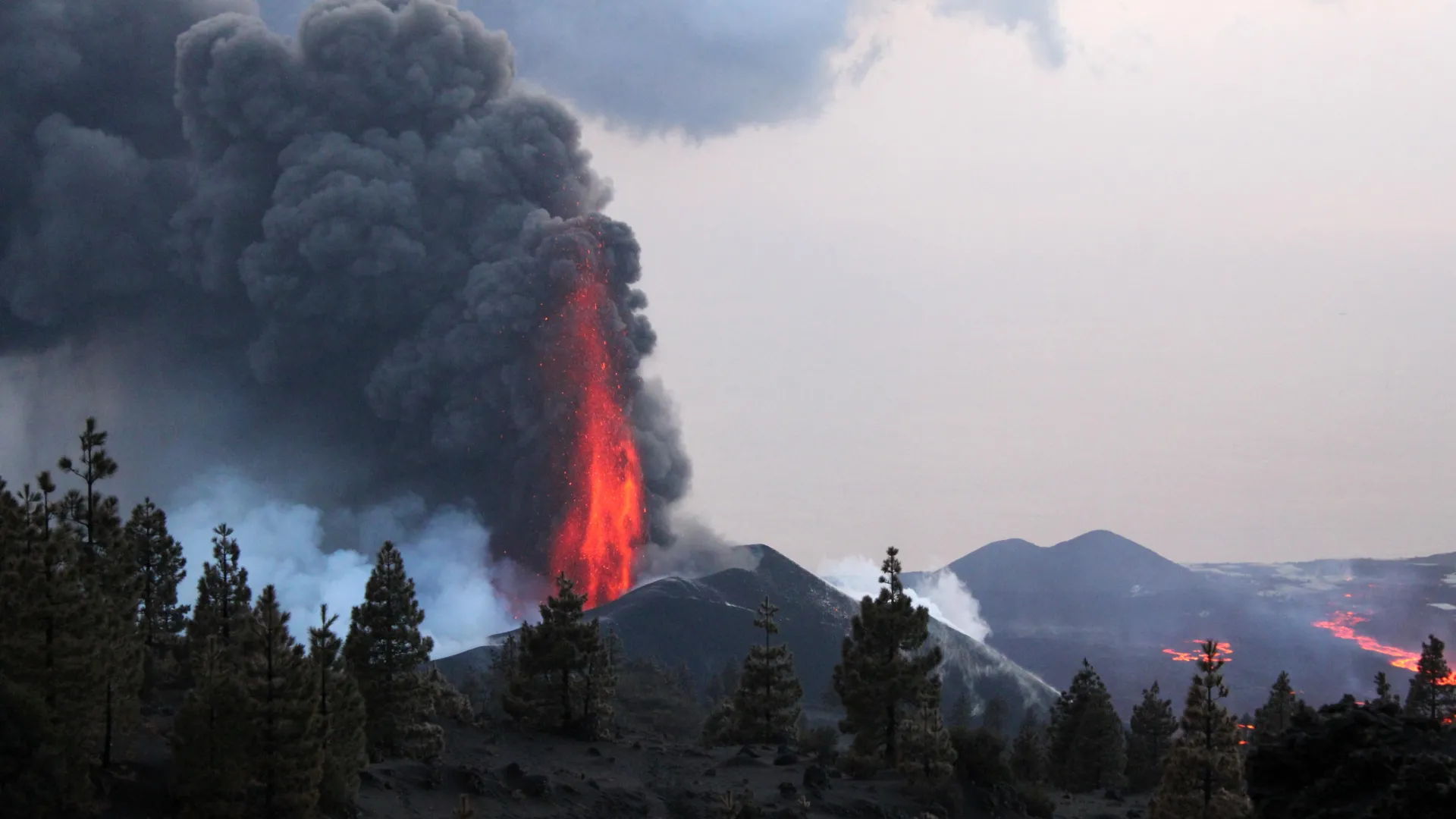
Why do some volcanoes send towering fountains of lava into the sky while others release molten rock in much calmer eruptions? Scientists have discovered that a hidden effect of extreme heat inside magma may help explain these striking differences. An international research team led by The University of Manchester investigated volcanic material from the 2021 Tajogaite eruption on La Palma, Spain.
Their findings reveal that a process known as "superheating" can dramatically slow the formation of crystals inside magma as it travels upward toward Earth's surface. Superheating occurs when magma reaches temperatures above those at which its crystals would normally remain stable. The researchers found that this extra heat can keep magma relatively fluid for much longer than expected, potentially allowing it to rise rapidly and produce spectacular lava fountains.
The discovery, published in Nature Communications, offers new insight into a long-standing question in volcanology: How does magma's temperature history influence the way a volcano erupts? How Extreme Heat Changes Magma Deep Inside Volcanoes Magma is a mixture of molten rock, gases, and sometimes solid crystals beneath Earth's surface. Once it emerges from a volcano, it is called lava.
Although temperature and chemical composition are important in determining how magma behaves, the new research suggests that the heating it experienced before an eruption can also make a major difference. Under normal conditions, crystals begin forming as magma cools. This process often starts around tiny existing crystals that act as "seeds," providing surfaces on which additional crystals can grow.
Superheating can disrupt this process in two important ways. First, sufficiently high temperatures can dissolve the microscopic crystal seeds that would otherwise encourage new crystals to develop. Second, the heat changes the internal structure of the molten material, making it more uniform and less favorable for new crystal formation.
These changes matter because crystals affect magma's viscosity, which describes how easily a substance flows. As more crystals develop, magma generally becomes thicker and more resistant to movement. This can influence both its speed of ascent and the way trapped volcanic gases escape.
Extract — continue reading at the source.