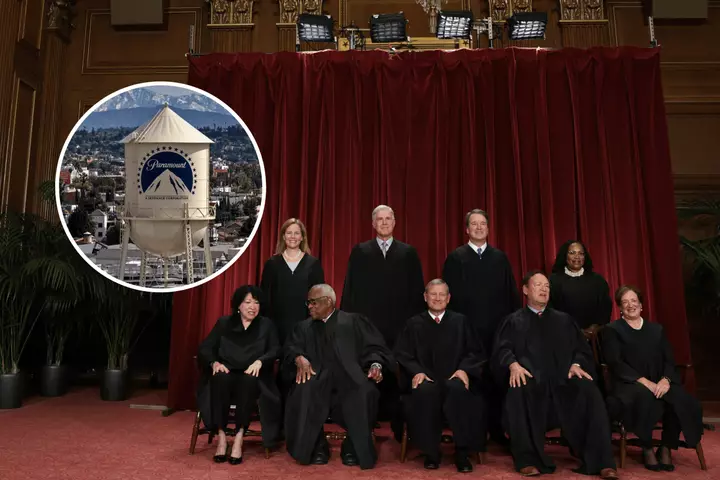
The Supreme Court justices laughed at a lawyer’s answer during arguments in the case Salazar v. Paramount Global, which could have consequences for digital privacy litigation. The case deals with the Video Privacy Protection Act of 1988, a law that was intended to protect consumers’ personal information.
The Court has been asked in this case to consider how the law applies in a more modern, digital landscape. The Court heard arguments in the case on Wednesday. The case was brought by Michael Salazar, who argues that Paramount violated the law by disclosing the history of videos he has watched on its website 247Sports.com to Facebook without his consent, citing the 1988 law that prohibited video providers from disclosing a person’s personal identification information and viewing information without their consent.
Salazar has been involved in a similar case with the NBA. Paramount, however, has argued that Salazar does not qualify as a protected consumer because he subscribed to a newsletter, rather than to a video service specifically. Paul Clement, an attorney for Paramount Global, provided several hypotheticals.
Chick-fil-A, for example, may have videos on its website but would not be considered to be in the business of providing video services. But if you go to the website, the first thing you'll see is like a video starts playing. You don't even have to click on anything, it just starts playing,” he said.
You don't think of that if it's anything other than chicken. But there are a lot of stores that sell a lot of different things, including the type of videos that we're talking about. So I don't know why we should focus just on the easy hypotheticals,” Roberts said.
Clement’s response drew laughter from the justices. He said it is his “job to focus on” the easier hypotheticals, prompting laughter. Roberts responded that he would think that his job is “to focus on the hard ones, at least for me.” “Your job is to direct to the harder hypotheticals.
Extract — continue reading at the source.