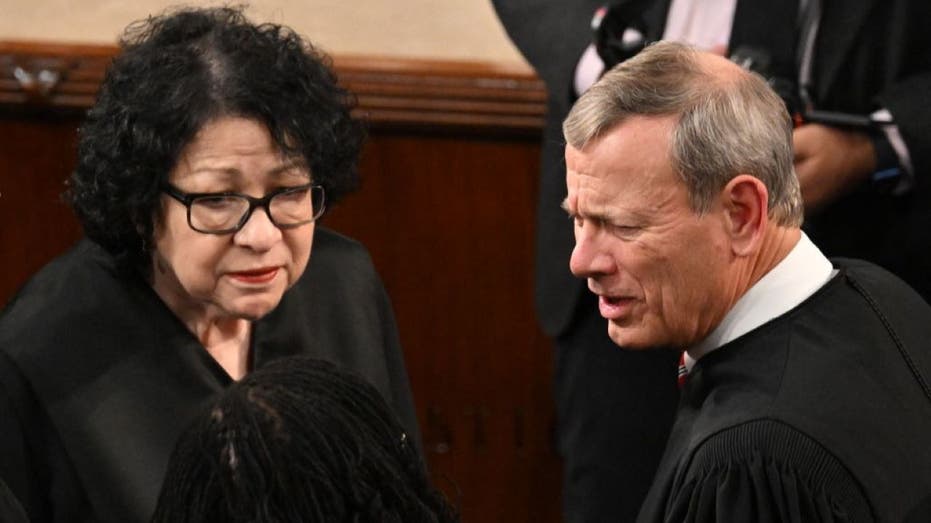
The Supreme Court begins its new term Monday, with renewed public and political concern over their recent rulings, the justices' personal safety and even their future makeup. Chief Justice John Roberts, surrounded by his eight colleagues, will call the court into public session precisely at 10 a.m. EDT with a pair of scheduled oral arguments.
Their first case from the bench will be a major one: a federal-state environmental dispute over holding oil and gas companies liable for climate change harms. Other high-profile appeals are already on the argument docket: NEWSOM PROMISES NEW LEGAL FIGHT AFTER TRUMP GETS SUPREME COURT VICTORY ON MAIL-IN VOTING But the Supreme Court under Roberts' leadership continues to struggle against negative public attitudes over their reputation as a non-political actor upholding the law and Constitution. "The chief justice is in a tough position in that he is an institutionalist and a traditionalist at a time in our nation's history where a lot of institutions and traditions have come under pressure like they haven't in a long time," said Thomas Dupree, a leading appellate attorney and former top Justice Department official.
"And so in many ways, he is trying to kind of buck a lot of the tide right now by really insisting and hewing to these traditions of the institutions that have governed Washington for a long time." The new term will feature more constitutional disputes over the power of the executive, with current or anticipated fights over immigration, federal bureaucracy reforms and possibly the White House ballroom and Kennedy Center construction projects. And if recent history is any predictor, the justices are likely to offer a mixed, nuanced series of rulings both for and against President Donald Trump's ambitious agenda. The last term saw him and his allies lose over sweeping reciprocal tariffs, birthright citizenship and removal of Federal Reserve governors; but prevail on various immigration policies, mid-decade redistricting and political gerrymandering, and federal campaign spending.
For the most part, the 6-3 conservative majority has greenlighted the administration's power, especially in a series of preliminary decisions from its so-called "shadow docket" that allow Trump to move ahead – for now – on a range of issues. The Trump Justice Department has won over 70-percent of its emergency cases before the Supreme Court since 2025 – applications that ask a challenged executive policy be enforced temporarily, while the larger issues are further litigated in the lower courts. Those included new federal rules for verifying a voter's citizenship status ahead of the November midterms; and approval for continued construction of the ballroom.
Decisions in Trump's second term have him and Republican lawmakers sharply criticizing their judicial losses on one hand, and Democratic leaders sounding the alarm when their side does not prevail. The judiciary has always weathered such criticism, but the personal tone of the attacks has only increased, as have the calls for sweeping accountability. Those on the right have demanded impeaching federal judges who block White House policies, while those on the left have renewed calls for drastic changes to the court's structure.
The president himself amped up the tensions dramatically, after losing a key decision over federal efforts to restrict mail ballots for the midterm elections. In a wild Truth Social post, he took aim at the three members he appointed to the bench – Justices Neil Gorsuch, Brett Kavanaugh and Amy Coney Barrett. "These are not the people I interviewed to serve on the United States Supreme Court, they are merely a shell of their original selves," wrote Trump after the September 14 ruling, adding, "The Court’s inability and unwillingness to do the right thing for our Country will go down, in a very negative way, in the annals of History." Those on the left have their own beefs.
Extract — continue reading at the source.