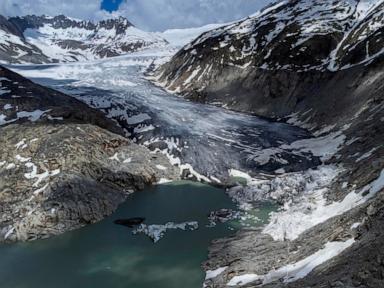
Experts report that glaciers in Switzerland have lost 5.5% of their ice volume this year due to heat waves and low winter snowfall ZURICH, Switzerland -- Glaciers in Switzerland – the home to the most in the Alps – lost 5.5% of their ice volume this year, the second-biggest percentage drop on record due to heat waves and low winter snowfall, experts report. The trend has worsened in recent years: Over the past five years alone, the volume of ice in Switzerland has declined by nearly a fifth, the experts say. The report testifies to the latest concerns that global warming is wreaking havoc on Europe, the world’s fastest-warming continent.
It’s as simple as that,” said Matthias Huss, who heads GLAMOS. Huss said the snow cover in winter was important for two reasons. The longer you have snow, the longer you avoid the loss of old ice,” said Huss in an interview at the Federal Polytechnic Institute ETHZ, where he is a glaciology professor.
The more snow you have, the higher the potential to keep some of the snow at high elevation and to form new ice,” Huss added. The great thaw in Europe’s legendary Alps is not alone: Experts say global warming helped to destabilize a Himalayan slope that collapsed in August and unleashed catastrophic and deadly flooding across Nepal. Satellites have shown vast shrinkage of glaciers in places like Greenland and Antarctica over the last half-century or so.
In Switzerland, in absolute terms, volume lost has been less than that in 2003, but the percentage decline this year is greater. That’s because the total volume today is roughly a third of that 23 years ago. Back then, the relative loss was 3.5% of total ice volume in Swiss glaciers.
Such accelerated ice melt has had an impact in Switzerland — the loss of 2.2 trillion liters (581 billion gallons) from July to September amounts to four times the annual consumption of water in the country of about 9.1 million people. Switzerland gets more than half of its electricity from hydropower. But the impact of accelerated glacier melt ripples far beyond: Switzerland is the water tower of Europe, and feeds some of the continent’s most important rivers: the Danube, Po, Rhine and Rhone.
The experts say the “extreme melting” faced by Switzerland’s glaciers this year included a decline in the average thickness of individual glaciers between 2-1/2 and 4 meters (about 8-13 feet) — and a reduction of up to 10 meters (33 feet) on the tongue of some glaciers. The expert teams have fanned out to assess runoff and crevices caused by the running water through the glaciers, in part by dumping red dye into the streams to track the water flows. The Allalin, Clarident, Rhone and Aletsch glaciers — Aletsch being the largest in the Alps — were among the glaciers to experience their biggest melt on record this year.
Extract — continue reading at the source.