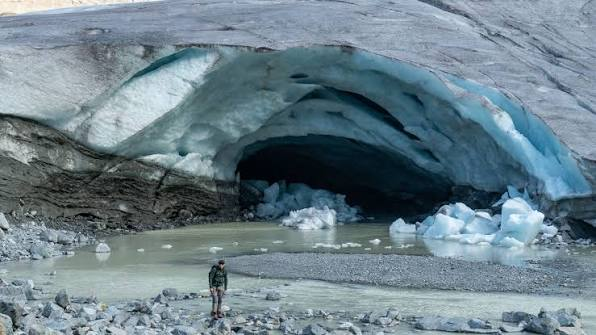
Swiss glaciers are continuing to shrink at an alarming rate. According to the latest observations from the Glacier Monitoring Switzerland (GLAMOS) network, the country’s glaciers suffered another exceptionally large loss of ice during the 2025/26 hydrological year. Scientists say the unusually low amount of snow accumulated during the winter of 2026 left glaciers with very little protection from summer melting.
GLAMOS measurements showed that snow depths were well below average, with some regions recording amounts close to historic lows. The monitoring programme, led by glaciologist Matthias Huss, combines field measurements with meteorological data, satellite observations and other remote-sensing techniques to track changes across the Swiss Alps. GLAMOS systematically monitors glaciers throughout Switzerland and maintains long-term records of their mass and volume.
The latest results add to a worrying trend that has accelerated in recent years. Researchers have noted that Swiss glaciers have been melting at exceptionally high rates since 2022. ETH Zurich scientists say current melt rates are roughly twice the average observed between 2010 and 2020.
The consequences extend far beyond the appearance of the Alps. Glaciers act as natural water reservoirs, releasing meltwater during the warmer months. As their ice reserves decline, they can temporarily provide more water during periods of intense melting — but once enough ice disappears, that additional water supply will also diminish.
One striking example is the Gries Glacier, where GLAMOS recorded a mass balance of about −3.5 metres of water equivalent for the 2025/26 observation period. The situation also puts Switzerland's iconic mountain landscapes at risk. Scientists warn that continued warming could fundamentally reshape the Alps, with some smaller glaciers potentially disappearing altogether in the coming decades.
Perhaps the most important point is that glacier loss is not simply a matter of losing ice. These frozen reservoirs influence river flows, ecosystems, hydropower and water availability, meaning that what happens high in the Alps can eventually affect communities far downstream. And there is a striking paradox: glaciers can release enormous amounts of water while they are rapidly shrinking, but this apparent abundance is temporary.
Extract — continue reading at the source.