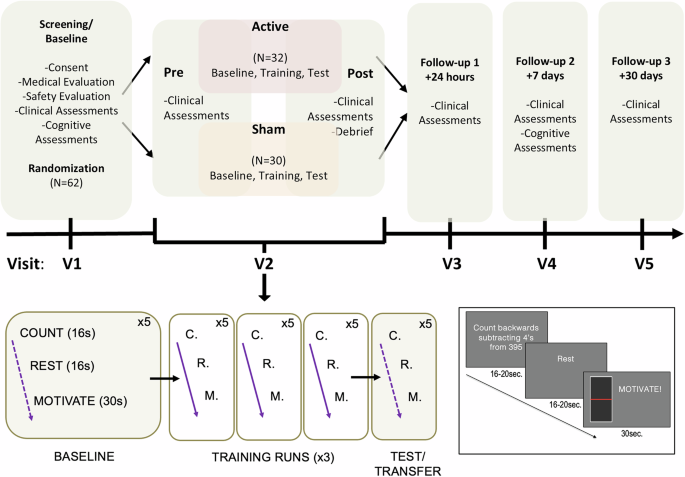
The significant heterogeneity of major depressive disorder (MDD) requires the development of interventions that directly target underlying cognitive or neurobiological mechanisms. This work tested the efficacy of self-modulation of the dopaminergic midbrain with high-field 7-Tesla functional MRI biofeedback in a randomized, controlled, proof-of-principle trial that targeted motivation regulation. A total of N = 62 unmedicated participants (MDD and healthy controls) were randomized to receive either Active or Sham 7-Tesla functional MRI biofeedback and completed clinical assessments pre- and up to 30-days post-training.
Factor analysis of clinical symptom change revealed a single latent clinical improvement factor that was significantly improved in the Active MDD compared to the Sham MDD group, immediately post-training (β = 15.85, t = 2.31, p = 0.03), and at 24-hours post-training (β = 22.84, t = 2.45, p = 0.02); effects were diminished and no longer significant at 7-day and 30-day follow-ups. Results of specific phenotypic clinical analysis revealed that depressed mood (F = 5.04, p = 0.029) and negative affect (F = 5.21, p = 0.027), but not positive affect, were most improved by the Active biofeedback intervention. Active biofeedback training engaged functional coupling over time between the VTA and the lateral frontal cortex in the MDD group (F = 6.03, p = 0.017), and greater overall VTA regulation was associated with clinical improvement (R = 0.268, p = 0.048).
Together, these results indicate the potential utility of dopaminergic midbrain-based biofeedback training for improvement of mood and negative affect in MDD. Major depressive disorder (MDD) is one of the leading mental health disorders worldwide, responsible for a significant number of years of healthy life lost to disability, resulting in huge socioeconomic costs [1,2,3]. MDD is a highly heterogeneous disorder, with a range of symptom presentations, including changes in appetite, sleep, and concentration, alongside two core symptom domains: low mood and anhedonia (a lack of interest or pleasure in previously pleasurable activities) [4, 5].
This heterogeneity partly explains the widespread lack of treatment efficacy, whereby approximately half of individuals with MDD do not respond to first-line oral antidepressants [6,7,8], and nearly half are not taking any medication at all, citing skepticism about treatment effectiveness [9]. Thus, the development of interventions based on targeting the underlying cognitive or neurobiological mechanisms is key to the advancement of targeted precision medicine approaches for MDD. Low mood and anhedonia are mediated by a range of biological and cognitive mechanisms, including biases in processing positive and negative information.
Individuals with MDD demonstrate difficulties in accurately processing positive, rewarding information, including money, social rewards, and positive emotions [10]. Reward sensitivity and learning are mediated by the dopaminergic network, stemming largely from the ventral tegmental area (VTA) and substantia nigra (SN). While cognitive training interventions targeting reward and motivation processing for depression have shown some promise [11, 12], there has been recent interest in supplementing cognitive training with biofeedback, i.e., presentation and self-regulation of a biological signal, such as heart rate or breathing rate [13], and as a way to boost CBT effects [14].
Indeed, some of the earliest work two decades ago empirically testing the efficacy of heart rate-based biofeedback interventions for MDD over 6–10 sessions showed improvements in depression severity [15], and overall good efficacy despite significant study heterogeneity [16]. Early work utilizing neural signals during biofeedback training (i.e., neurofeedback), with signals from electroencephalography (EEG) [17], functional MRI (fMRI) or functional near-infrared spectroscopy (fNIRS), have also shown some promise [18, 19]. Some of the first randomized controlled trials of fMRI-based biofeedback training that targeted emotional networks yielded mixed results [20, 21], indicating no group differences in clinical outcomes in medicated MDD individuals with moderate symptom severity [20].
Extract — continue reading at the source.


