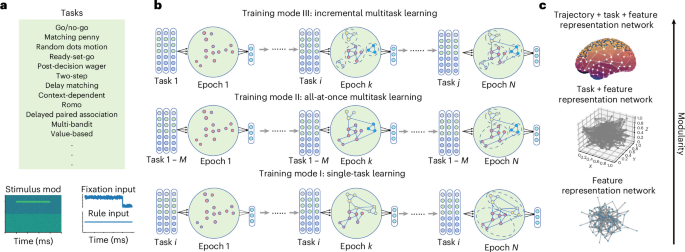
Understanding how neural systems develop modular organization is fundamental to both neuroscience and artificial intelligence. Modular architectures are thought to be critical for adaptability and complex cognitive performance by enriching the brain’s ability to integrate and process information. While prior work posits that modularization emerges from physical constraints, such as minimizing metabolic wiring costs, these spatial models alone do not fully explain the functional organization of brain networks.
A critical, unanswered question is how the functional demands of learning complex tasks computationally influence network topology. Here we demonstrate, using recurrent neural networks trained on cognitive tasks, how functional demands shape structural organization. We find that multitask learning paradigms enhance network modularity compared with single-task training, especially when task load strains the network’s capacity.
Networks trained with incremental multitask learning, in particular, develop the highest degree of modularity and maintain superior performance. Furthermore, these task-induced networks exhibit structural properties that more closely resemble biological brain networks than models based solely on spatial constraints. These results provide a controlled computational account showing that functional demands can induce modular organization in artificial recurrent networks under capacity constraints, suggesting modularization as an adaptive response to the sequential introduction of complex tasks.
This is a preview of subscription content, access via your institution Access Nature and 54 other Nature Portfolio journals Get Nature+, our best-value online-access subscription Receive 12 digital issues and online access to articles Prices may be subject to local taxes which are calculated during checkout Most of the data used in this work were generated through Python-based simulations, as described in the ‘Code availability’ section. The structural connectivity data were derived from the Human Connectome Project (HCP)58. Specifically, we selected 84 cortical areas and computed the mean inter-regional distance matrix and structural connectivity matrix among these regions.
These processed data files are provided in formats compatible with Python and are publicly available via GitHub at https://github.com/brain-intelligence-lab/modular-brain-rnn and via Zenodo at https://doi.org/10.5281/zenodo.21863683 (ref. 59). Source data are provided with this paper. The source code for the analysis is publicly available for peer review and reproducibility via GitHub at https://github.com/brain-intelligence-lab/modular-brain-rnn and via Zenodo at https://doi.org/10.5281/zenodo.21863683 (ref. 59).
Psychol. 67, 613–640 (2016). Functional network organization of the human brain. Neuron 72, 665–678 (2011).
Extract — continue reading at the source.


