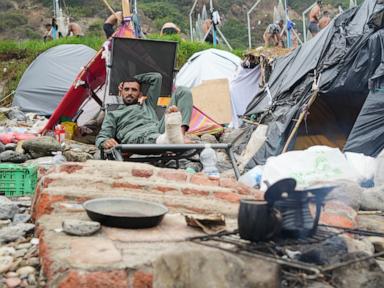
The Spanish city of Ceuta on the northern African coast normally celebrates its official holiday on Sept. 2 all on its own CEUTA, Spain -- The city of Ceuta, a tiny speck of Spanish territory perched on the northern African coast, normally celebrates its official holiday on Sept. 2 all on its own, ignored by the mainland. Not this year, not after Ceuta became the epicenter of Spain's worst border crisis in living memory. What would’ve been the city’s annual day of celebration is instead overshadowed by a humanitarian crisis that is generating tensions in the tiny exclave, on the mainland and even spilling over into other countries.
In lieu of festivities in Ceuta, a protest is the main event. There are also demonstrations planned in cities across Spain, whose prime minister has alleged — without presenting any evidence to the public — that other nations spread disinformation to cause the crisis. Last month, about 72,000 people poured into the small Spanish territory neighboring Morocco, with at least 90 dying in the effort to reach Europe.
Most of the migrants quickly returned or were ushered back over the border, but around 5,000, including 1,200 minors, remain in Ceuta weeks later, according to the national government. Difficult questions likewise linger over what caused the mass crossing that the government says was fueled by an online campaign on social media. The sudden influx of tens of thousands of migrants into Ceuta, which has a population of about 84,000, put a huge strain on resources and angered many residents.
Local authorities said that Spain's central government ignored warning signs before the border was breached. The PP and Spain's far-right Vox party have latched onto the Ceuta crisis and made it the focus of a political fight to oust the left-wing government of Prime Minister Pedro Sánchez in Madrid. The organizer of Wednesday's protests scheduled at 8 p.m. in Madrid and more than 200 other towns is the officially nonpartisan Spanish Federation of Municipalities and Provinces.
But the protests are being promoted by PP and Vox, which is strongly against irregular migration. Spain’s minister of territorial policy, Ángel Víctor Torres, told Spanish National Radio on Wednesday that the protests were politically motivated. Spain's government denied criticism it has left Ceuta behind.
This week, it earmarked 309 million euros ($357 million) to aid Ceuta's social services, with special attention to housing migrants, its economy and security. Many in Spain have asked if Morocco's government could have done more to prevent the frontier breakthrough. Sánchez, however, has repeatedly defended the Moroccan authorities, saying they were swift to help in the return of most of the migrants.
Extract — continue reading at the source.