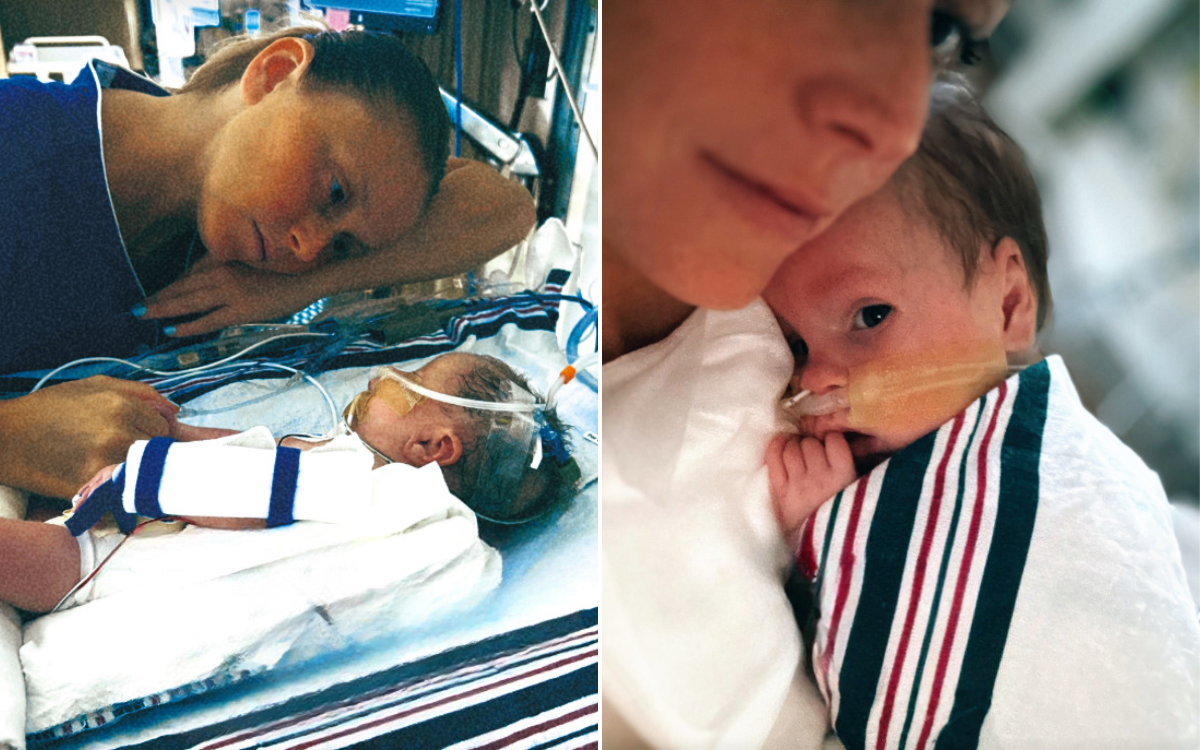
Looking back, Brooke Buckley says her pregnancy with her youngest son, Palmer, always “felt different.” "Because I had already experienced a healthy pregnancy, I knew what movement was supposed to feel like at different stages," Buckley told Newsweek. "I remembered the little flutters and movements that begin in the second trimester, so I was always confused about why this pregnancy felt so different. By my third trimester, I had a gut feeling that something was off." Doctors attributed her concerns to an anterior placenta and excess amniotic fluid.
Non-invasive prenatal testing also showed no issues, but Buckley remained uneasy. "I remember one obstetrician appointment where, after doing my own research, I tried to connect the excess fluid, breech position and lack of movement to a rare condition I had come across," she said. "I was told to stop Googling because something like that would be extremely rare and unlikely." There were other warning signs though.
At Palmer's 20-week anatomy scan, he was measuring small, and clinicians struggled to observe him swallowing. His heart rate also dropped several times during the appointment. As her due date approached, Buckley recalls being reassured that Palmer was a “healthy baby” and no further monitoring was needed.
She remembers every detail of the day he was born. After a planned C-section, she expected the moment she'd seen in so many birth stories: doctors lifting her baby up to her to meet for the first time. Instead, she watched her husband's expression change as doctors rushed to assess Palmer.
Palmer had his umbilical cord wrapped around his neck several times, but the greater concern was that he wasn't crying. "He was very floppy and wasn't breathing or swallowing on his own," Buckley said. "They didn't know why, but they immediately got to work trying to help him." As Palmer was taken from the room, Buckley was overcome with anxiety.
"I never got to see or hold him after he was born," she said. "The only way I saw his face was through the pictures my husband had taken." In the days that followed, Buckley and her husband faced unimaginable questions, including whether they wanted to remove his life support. At the same time, they were trying to understand a diagnosis they had never heard of: a rare mutation of the ACTA1 gene.
Extract — continue reading at the source.