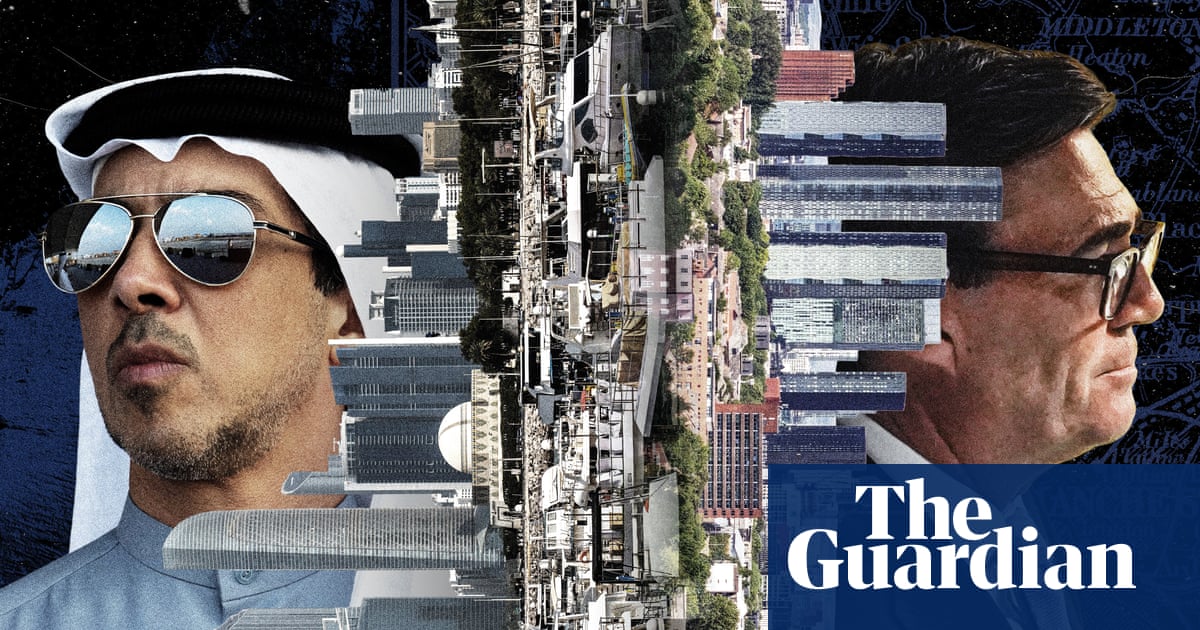
When Hosni Mubarak, Egypt’s long-ruling dictator, was toppled from power in the Arab spring protests of 2011, his downfall sent shock waves across the Middle East. It also helped change the face of modern Manchester. Mubarak’s successor, the Muslim Brotherhood leader Mohamed Morsi, was a sworn enemy of the United Arab Emirates, whose rulers feared the advance of Morsi’s Islamism.
The UAE, a key western ally, was concerned that David Cameron’s UK government was not strong enough on the Muslim Brotherhood and warned ministers it could pull billion-pound arms deals if Britain did not act. A secret Whitehall unit was hastily established to keep the oil-rich emirates on side. Lucrative investment deals were offered in private meetings later revealed by the Guardian.
One of these would turn Abu Dhabi’s now crisis-stricken ownership of Manchester City football club into a much deeper stake in the city itself. Fifteen years after the Egyptian revolution, a Guardian analysis can reveal a stark rise in the amount of land and property owned by the UAE government or Emirati developers in Manchester over the past decade – extending to the size of 260 football pitches at its peak in 2023. Manchester City’s owner, Sheikh Mansour bin Zayed al-Nahyan, has built an extensive portfolio outside the club, including the UK’s biggest indoor arena, an “upper-upscale hotel” that opened last month, a suite of apartment blocks and investment in world-leading university research through a firm run by Khaldoon al-Mubarak, the City chief executive.
The cheating scandal at Manchester City has put the spotlight on the wider influence of Abu Dhabi in the city, the growth of which helped power Andy Burnham to Downing Street. Through interviews with key past and present local politicians and officials, new data analysis and an examination of public records spanning more than a decade, the Guardian can now tell the story of how the oil-rich state’s influence has grown, what it has meant for Manchester, and how it has fuelled concerns about the city becoming “a northern version of London”. Ten years ago, the sight of the murky-green Rochdale canal was a sign you had strayed too far out of Manchester’s lively Northern Quarter and should turn back.
Now drinkers and diners gravitate to the area, pulled in by trendy waterside bars serving up £6.90 pints and an artisanal bakery where a single croissant costs £7.50. That transformation began in summer 2013, when David Cameron’s government sought to defuse tensions with the UAE and asked Manchester city council to draw up three investment proposals for the super-rich emirates. One of these resulted in a £1bn deal called Manchester Life, under which the council sold a prime slice of city centre land to Abu Dhabi for £5m to build 6,000 homes, along with a right of first refusal on other projects.
Richard Leese, the leader of Manchester city council at the time, told the Guardian: “That was a UK government-brokered deal and we were obviously seeking a very significant investment for what would in total have been a £1bn scheme. At that time there were no [other] developers who were either willing or able to do it.” In a press release, Leese hailed the partnership as a “world-class exemplar of regeneration” and “a platform for the delivery of more than 6,000 new homes”. However, only 2,039 homes have been delivered by Manchester Life – a third of the total promised – with a further 2,839 homes being built by other developers.
Extract — continue reading at the source.