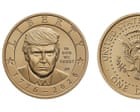
Two hallmarks of Donald Trump’s second-term: the president’s enthusiasm for putting his name and face on things, and his cavalier approach to established law. Today the president is once again combining both those interests, as the government releases a $1 coin bearing his image, an item of currency which scholars say should be illegal, but which is happening anyway. How many times have you heard that in the last 18 months?
The US has had a long tradition of not putting living people on US currencybeginning in the late 1700s when the US Mint, which manufactures and distributes currency, wanted to put an image of George Washington on US money. Washington declined, saying it would be too much like a monarchy putting its rulers on money. In 1866, Congress passed an amendment barring the “portrait or likeness” of living people from appearing on currency.
That doesn’t appear to have bothered Trump. His scowling face dominates the new $1 coin, which is legal tender, and looks gold but is actually made from zinc, manganese, nickel and copper. It costs $61 to buy 25 one-dollar coins – you do the math – and about 9m of the coins are being made.
They will, according to the US Mint, “honor 250 years of great American heritage”. That all sounds great, if you’re into that sort of thing, but what about the law?. Scott Bessent, the treasury secretary, has argued that during the 150th celebration of America’s “birthday”, the face of then president Calvin Coolidge appeared on a coin, so during the 250th, the Trump coin is fine.
The main problem seems to be that there’s a hodge-podge of laws which govern what can and cannot go on a coin. The 1866 ban on featuring living people arose from an impressively creative act of vanity. An incoming five-cent note was supposed to feature an image of the deceased explorer William Clark, but a treasury official called Spencer M Clark took advantage of the pair sharing a last name to instead print his own face on the note.
The problem was that members of Congress a) noticed and b) were unamused. They passed an amendment which ruled that US money can only feature dead individuals – but it only applied to paper money. In May, a group of Democratic members of Congress wrote to the treasury department in May, urging them to desist with the coin, pointing to a 2005 law which further restricted which presidents could appear on coins.
Extract — continue reading at the source.