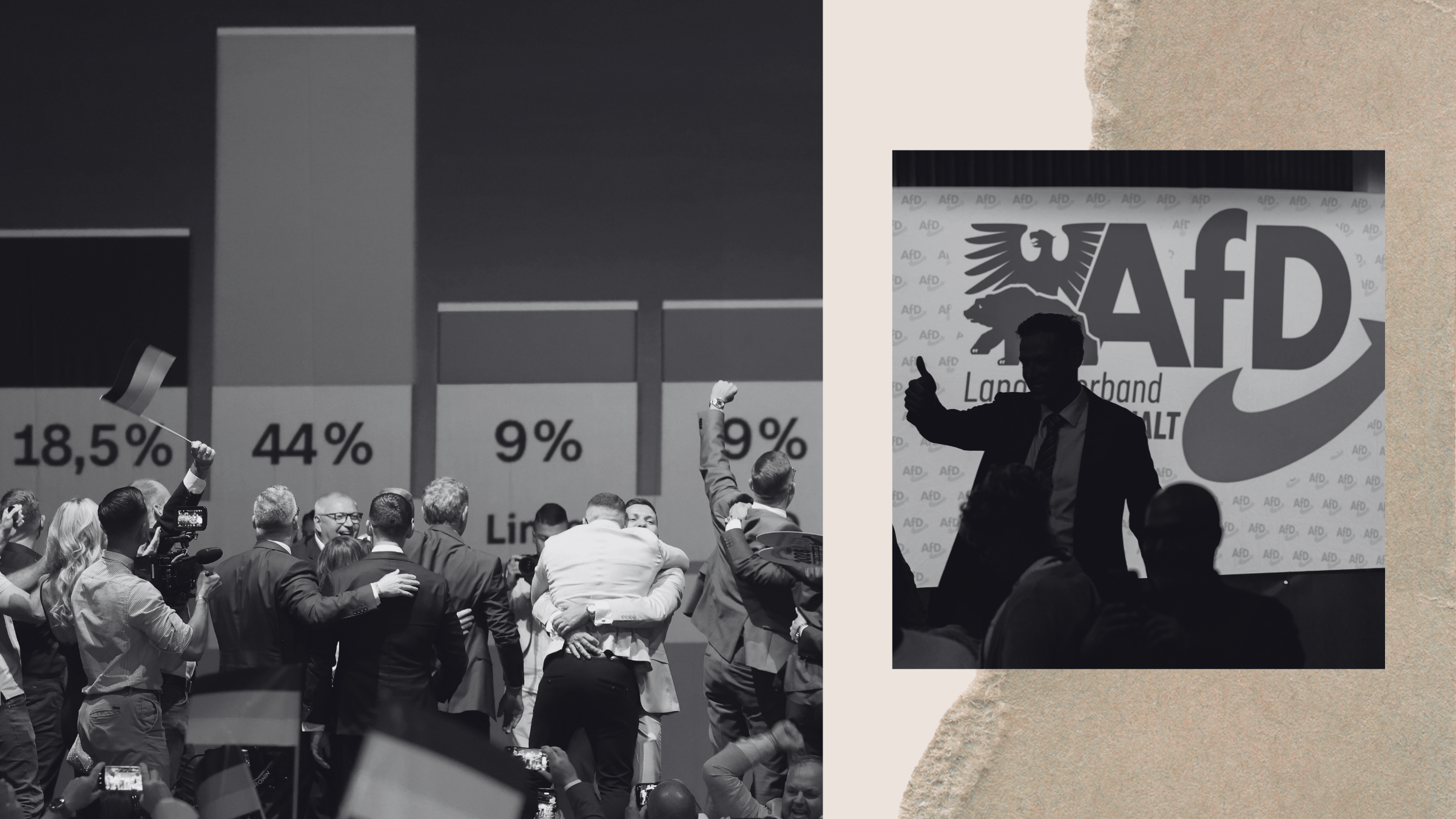
Like other populist movements that have dominated politics over the last decade, the AfD has not hidden its light under a bushel. It’s all there in black and white. At the start of its election campaign in Saxony Anhalt, the AfD published a 258-page manifesto bearing its motto: “Das Land Zuerst,” or “The Country First.” The manifesto promises large scale deportations of immigrants, including naturalized German citizens, under its remigration program, particularly targeting those who do not look or sound “German.” It seeks to change the history curriculum in schools to teach “more Bismarck and less Hitler,” emphasizing imperial achievements and national power while diminishing Germany’s postwar culture of remembrance and attention paid to Nazism and the Holocaust.
The manifesto promises to support “normal” heterosexual families and conventional households while withholding benefits and legal recognition from LGBTQ families and others it considers “deviant.” It aggressively opposes German military aid to Ukraine and insists that restoring friendly relations with Russia would provide cheaper access to energy and lower prices for Germans. The far right party’s manifesto is worth reading in full. It is no wonder that Germany’s domestic intelligence agency classified the AfD chapters in Saxony Anhalt and a neighboring state as right-wing extremist.
Yet it is worth admitting that a large number of Germans are finding this vision enticing. The AfD’s sweeping, simplistic promises offer a beguiling contrast with the gray incrementalism of politics as practiced by a succession of coalition governments in Berlin— a politics of hard truths and achingly slow progress, when there is any progress at all. Why vote for parties synonymous with budget cuts to balance the books, job losses amid fierce competition from China, and billions spent on rearmament when you can return to the secure world of yesteryear?
The AfD won voters away from all its mainstream rivals, winning over 82,000 voters who had previously supported the governing Christian Democratic Union of Germany (CDU). But one of the more striking consequences of the Sept. 6 election in Saxony-Anhalt was that the AfD energized people who had stopped voting, and brought 170,000 of them—around a tenth of the local electorate—back to the ballot box. These are people who had largely given up on politics, and who, for years, have inhabited a parallel universe.
Many of these voters regard Germany’s Nazi past as overblown and refuse to draw parallels between then and now. They also see centrist politics as the instrument of a deep state seeking to undermine their values. While reporting from Saxony-Anhalt, I was reminded of a small incident I witnessed before the pandemic.
I was walking along a street in Leipzig, one of the main cities of the former Communist East Germany, with a helpful contact, an intelligent local activist who had once worked for the Greens. As we passed the offices of MDR, the regional public broadcaster, she suddenly shouted, without provocation, “Lügenpresse”—“lying press,” or “fake news.” Startled, I asked what the station had done to earn her ire. The more I pressed her to identify the specific source of her grievance, the more agitated she became.
Extract — continue reading at the source.