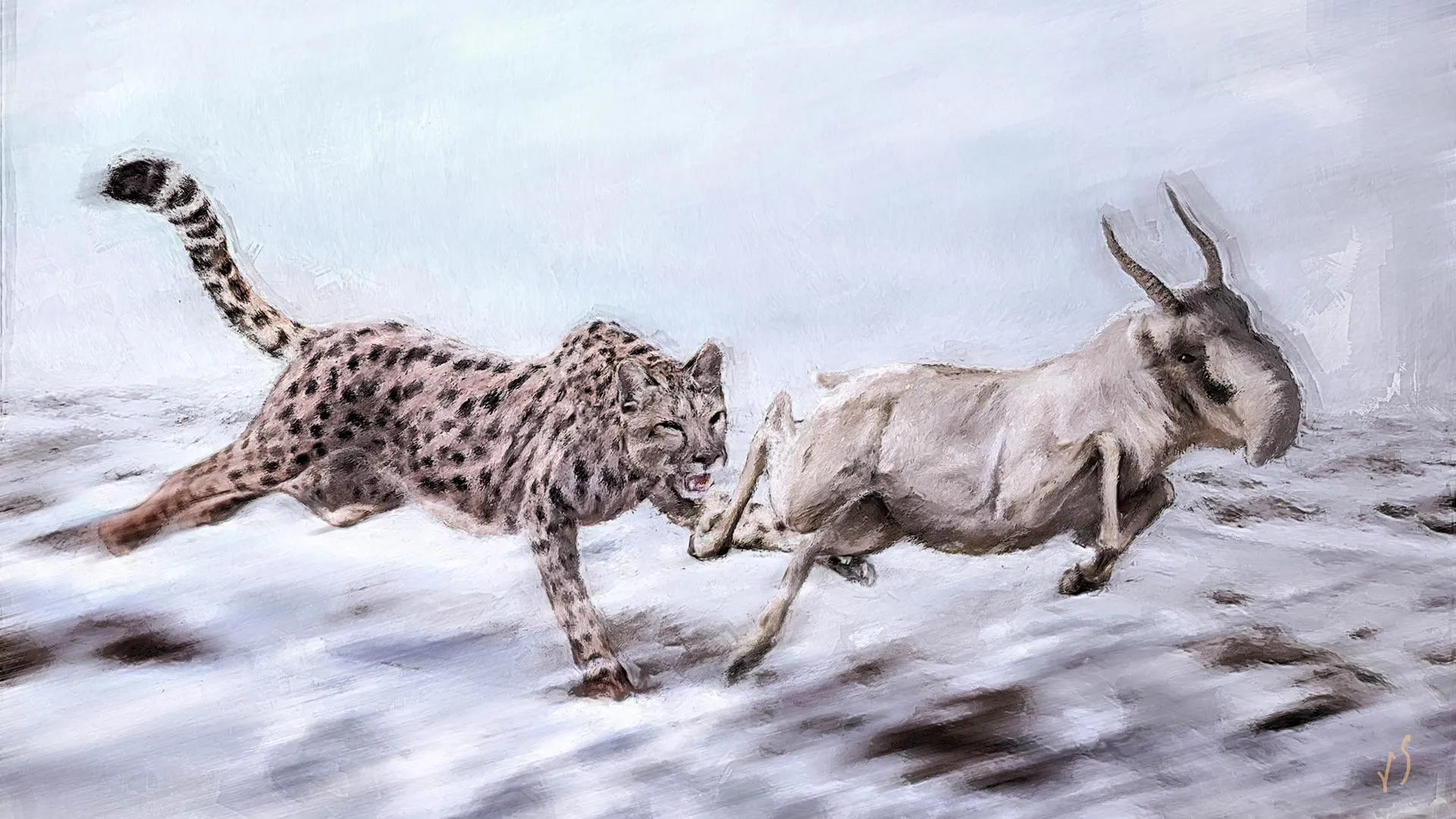
New research led by scientists at the University of California, Santa Cruz, is reshaping what is known about Miracinonyx trumani, the extinct North American predator commonly called the American cheetah. Evidence from nuclear paleogenomes and stable isotopes shows that the animal was not actually a cheetah. Instead, it was a highly adaptable close relative of the puma, and populations living in the far north appear to have relied heavily on fish to survive in Arctic environments.
The findings, published on September 4 in Current Biology, also extend the known range of the species by about 20 degrees of latitude farther north than scientists had previously recognized. In places such as Wyoming and Florida, M. trumani lived as a generalist predator in temperate grasslands. In the Arctic Yukon, however, the cats occupied a very different ecological role as tertiary consumers and likely specialized in anadromous fish such as salmon.
Adult Miracinonyx trumani are thought to have weighed about 150 pounds on average, stood roughly 3 feet tall, and measured around 8 feet from head to the tip of the tail. Their slim bodies and long front legs may have helped them travel efficiently through the open landscapes of Pleistocene North America. Although their proportions resembled those of modern cheetahs, growing evidence suggests these cats were much more versatile hunters, able to chase prey on land while also using powerful forelimbs to grab and hold it.
"These cats were remarkably flexible, much like pumas are across their range today," said Molly Cassatt-Johnstone, a Ph.D. candidate in the Paleogenomics Lab at UC Santa Cruz and lead author of the study. "We found loss-of-function mutations in certain genes that regulate circadian rhythms, suggesting they may have adapted to the extreme light cycles of summers and winters in northern latitudes." For many years, M. trumani played a major role in theories about the ecology of Ice Age North America. Scientists often pointed to the predator as a possible explanation for the extraordinary speed of the American pronghorn.
Under the "ghosts of predators past" hypothesis, pronghorns became exceptionally fast because they evolved alongside a cheetah-like predator capable of high-speed pursuit. Their speed, in this view, was an evolutionary defense against a hunter that later disappeared. The new genomic evidence changes that picture.
Researchers confirmed that M. trumani was a sister species of the modern puma and split from that evolutionary lineage about 2.6 million years ago. Its narrow, "cheetah-like" build therefore appears to be a vivid case of evolutionary convergence, in which unrelated species independently develop similar features because they face comparable environmental pressures. To investigate how the species survived in such different habitats, researchers sequenced high-coverage genomes from fossils that were between 23,000 and 31,000 years old.
Extract — continue reading at the source.


