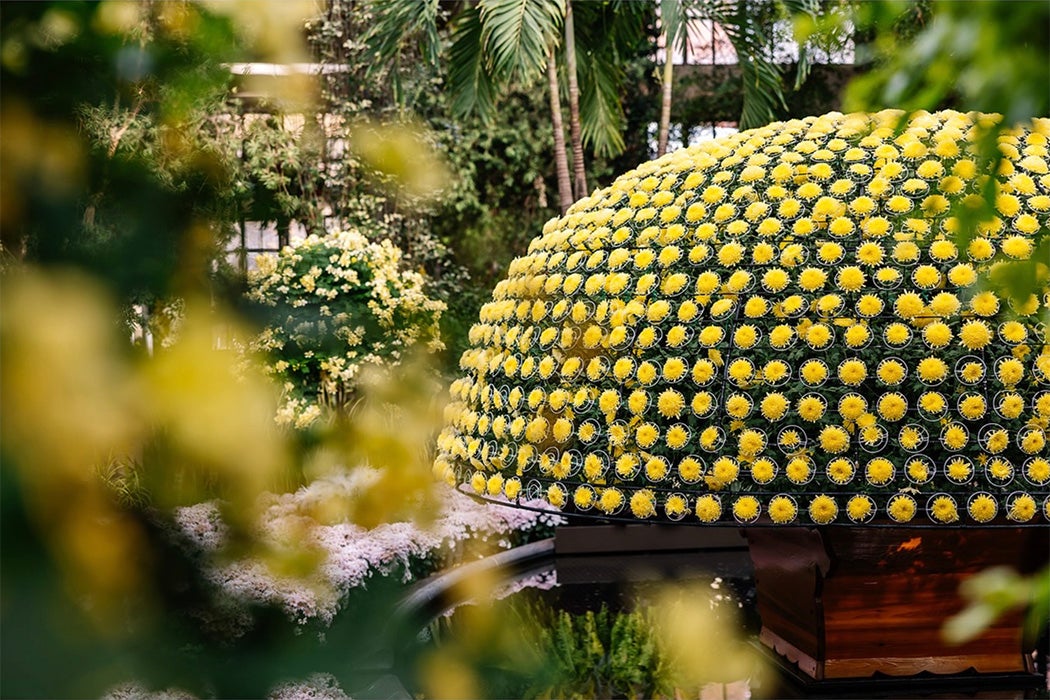
Visitors encountering the Thousand Bloom Chrysanthemum at Longwood Gardens in Pennsylvania often wonder what they are seeing. From a distance, the plant appears to be an immense floral dome, composed of hundreds—if not a thousand—of carefully matched chrysanthemums. Each flower occupies its own place in a near-perfect pattern.
The blossoms rise in concentric rows from the edge of the display toward its crown, creating an impression of abundance so extravagant that it seems possible only through multiplicity. If you linger to listen, you’ll hear many guests wondering if multitudes of plants have been assembled to produce this impressive form. Then comes the revelation: every blossom belongs to a single chrysanthemum.
Beneath the dome, hundreds of branches converge toward a single stem and root system. What appears to be a multitude is actually one plant (Chrysanthemum x morifolium), cultivated over approximately eighteen months and guided through thousands of individual decisions. The finished plant is not simply a profusion of flowers.
It is the record of time—of biological time, human time, and cultural time—made visible. At Longwood, the annual creation of a Thousand Bloom begins not with one plant, but with ten vegetative cuttings started each June, more than a full year before the exhibition. Artificial light interrupts the long autumn nights, keeping the chrysanthemums vegetative as horticulturists pinch the growing tips, encouraging one stem to divide into two, then four, until reaching over one thousand stems.
By November, the two strongest plants are selected and carried forward in parallel. As their root systems and branches expand, so do their specially constructed containers and supporting frameworks. Both plants are continually trained and tied to custom-made frames, which support the increasing weight of the stems while establishing the balance and form of the eventual dome.
Shoots are selected or removed; light, water, nutrition, temperature, and growth are carefully balanced. If both plants survive, the stronger of the two is chosen for display only shortly before the exhibition. As more than one thousand stems begin to set buds, the horticultural focus shifts from increasing their number to perfecting the flowers they will bear.
Extract — continue reading at the source.