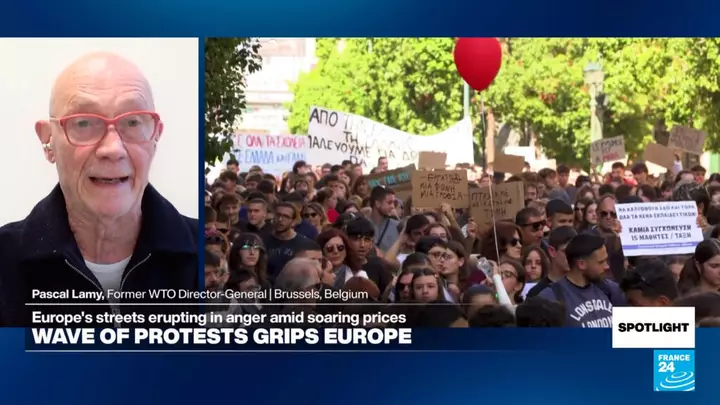
We and our partners do the following data processing based on your consent: store and/or access information on a device, personalised advertising and content, advertising and content measurement, audience research and services development ‘The best on Earth’: Can weak economic growth undermine Europe’s ‘very sophisticated social system’? To display this content from YouTube, you must enable advertisement tracking and audience measurement. One of your browser extensions seems to be blocking the video player from loading.
To watch this content, you may need to disable it on this site. Cover image: ‘The best on Earth’: Can weak economic growth undermine Europe’s ‘very sophisticated social system’? © France 24 Can Europe continue to sustain one of the world's most ambitious social models while falling increasingly behind its major economic competitors? For Pascal Lamy, former European Commissioner for Trade and former Director-General of the World Trade Organization, this question lies at the heart of the continent's mounting economic and political tensions.
Lamy looks beyond the immediate turmoil in France to identify a deeper European predicament: a widening disconnect between the continent's social commitments and its capacity to generate the economic growth needed to sustain them. "The common cause of these turbulences is the mismatch between a very sophisticated European social system, which is the best on Earth, and Europe's weak growth," he argues. His diagnosis is particularly stark: Europe's potential growth rate, he maintains, is only half that of the United States, one-third that of China and one-fourth that of India.
The implications extend well beyond public finances. Across Europe's diverse socioeconomic models, weak growth raises fundamental questions about the long-term sustainability of social protection, economic competitiveness and the political consensus underpinning the European social contract. France's unrest, in Lamy's interpretation, reflects both a distinctive national tradition of political mobilization and broader structural weaknesses shared across Europe.
Rising living costs, energy vulnerabilities and mounting pressures on lower-income households compound social tensions that cannot be explained by unemployment figures alone. These pressures also reveal Europe's exposure to geopolitical conflicts over which it exercises limited influence. Yet China's expanding industrial and commercial power introduces another consequential strategic dilemma.
As surging Chinese exports threaten the survival of parts of European industry, Lamy advocates a graduated response: negotiation first, stronger trade defenses if necessary. "There is a trade war, but this is not the European Plan A," he explains. Europe's preferred strategy, in his view, remains negotiated restraint rather than immediate escalation.
Extract — continue reading at the source.