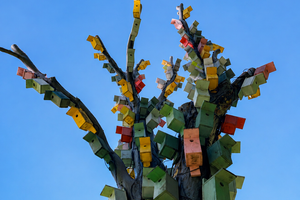
A bare tree in Riga’s Esplanāde is transformed into an extraordinary vertical neighbourhood by scores of colourful bird nesting boxes clustered across its trunk and branches. Looking up into the colourful bird nesting boxes that cover the trunk and branches of the Birdhouse Tree in Riga’s Esplanāde. In Riga’s elegant Esplanāde, one bare tree stands out from the surrounding greenery.
Its trunk and branches are crowded with scores of small wooden birdhouses, painted in an assortment of greens, yellows, reds, pinks and natural tones. From below, the collection is so dense that the boxes can initially resemble an unusual lighting installation. Look more closely and the circular entrances reveal them as nesting boxes.
Bird boxes have a practical role in Riga’s parks: the city’s park managers maintain, repair and install them to provide nesting places for cavity-nesting birds. This particular tree has been photographed and documented in Esplanāde since at least 2022. However, readily available official information does not establish who originally created it, exactly when it appeared, or how many of its boxes are occupied by birds.
Whatever its origins, the extraordinary concentration of colourful nesting boxes has turned an otherwise bare tree into one of the more unexpected sights hiding in plain view in central Riga. Get more unusual and extraordinary places each week with the Atlas Obscura Places newsletter. Your newsletter subscriptions with us are subject to Atlas Obscura's Privacy Policy and Terms of Use.
The Birdhouse Tree is in Esplanāde, a central Riga park beside the Latvian National Museum of Art and the Nativity of Christ Orthodox Cathedral. It is an easy walk from the Freedom Monument and Riga’s Old Town. There is no admission charge; for the best view, stand close to the trunk and look upward through the mass of colourful boxes.
The last orange grove of the San Fernando Valley is owned and protected by CSU Northridge. This great tree was gifted to Monterrey in 1996, the 400th anniversary of the city's foundation. Maine’s largest salt marsh hides old roads, drainage ditches, and the remains of a canal once cut through its grasses.
Extract — continue reading at the source.