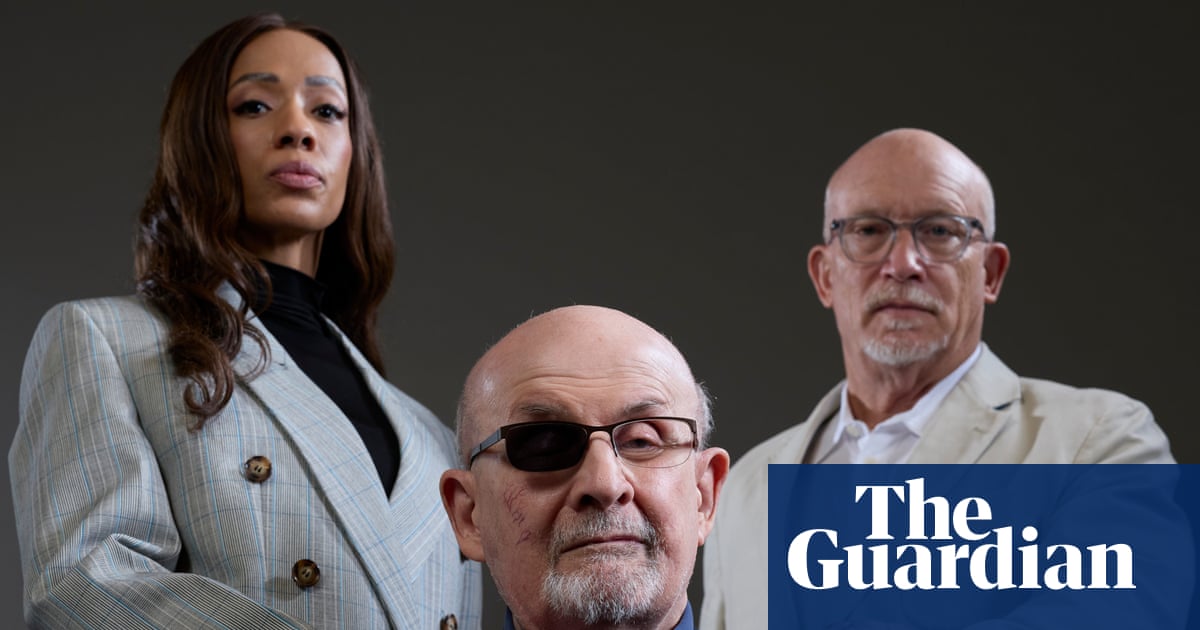
Eliza Griffiths was at home in New York, drinking a second cup of coffee one August morning in 2022, when her phone rang. She answered it to a frantic friend, who told her the man she had married just a year earlier, and who had set off the previous night for a speaking engagement nearly 400 miles away, had been hurt. Turning on the television, she was assaulted by blurry images of chaos on stage as audience members surged to the rescue.
Her husband, Sir Salman Rushdie, had been stabbed multiple times and was fighting for his life. Within days of desperately chartering a plane to fly her to Rushdie’s hospital bedside, not knowing if he was alive or dead, Griffiths – a poet and photographer who works under her full name Rachel Eliza Griffiths – had begun to make a video diary recording his treatment and recovery. By which I meant something very modest: maybe she would take a picture of me on her iPhone every couple of days just to document the recovery, but Eliza had bigger ideas.” One of her first ideas was that it needed to be shot not on a phone but with a proper camera.
The person I used to be, even just 24 hours ago, was being returned to me. It was giving both of us this permission to continue to be artists and tell our stories together.” The couple are sitting in separate rooms of their New York home to tell their shared story over video link. Griffiths is warm and animated, as the memories rush out.
Rushdie is more reserved and sardonic, smartly turned out, with only a black lens over his right eye to attest to the horrific injuries he suffered. Both have already published memoirs about the experience: Rushdie’s Knife, in 2024 and Griffiths’ The Flower Bearers earlier this year. Now they are the subjects of an unflinching film, Knife: The Attempted Murder of Salman Rushdie, which combines Griffiths’ video diary with archive footage from the period following the fateful day in 1989 when a fatwa was issued against Rushdie for the offence allegedly caused to Islam by the supposed blasphemy of his fourth novel, The Satanic Verses.
Iran’s then supreme leader, Ayatollah Ruhollah Khomeini called for the execution of the 41-year-old author and his publishers, forcing him into hiding, where he remained, under armed guard, for nine years. It is hard to say which time zone of the film is more viscerally shocking: the grisly footage of Rushdie being stitched and stapled back together in 2022, or the murderous hatred that roars out from news headlines in the months and years following the fatwa. In the US, the office of the Riverdale Press newspaper is firebombed after it runs an editorial about the book defending free expression; in Pakistan, six people are killed in riots; in Japan, a translator is stabbed to death; in Italy, another translator is stabbed in his home, while, in London, an effigy of a mutilated Rushdie is paraded through the streets by a furious crowd, some of whom declare on camera that nothing less than hanging will satisfy them.
Incorporating the archive footage was the idea of Alex Gibney, an Oscar-winning documentary maker (his newest film is a four-hour study of Elon Musk) who was invited by Rushdie and Griffiths to direct – or, as he describes it, “curate” – the film. Rushdie was initially opposed to dredging up the past, reasoning that his attacker – known simply as “A” in both his memoir and the film – was “just one crazy kid”. Yet just three years before the attack, at a talk hosted by the Guardian at the Sheldonian in Oxford for his Booker-shortlisted novel Quichotte, he was tetchy to find plainclothes police at the entrances, complaining that only in the UK was such security still deemed necessary.
Extract — continue reading at the source.