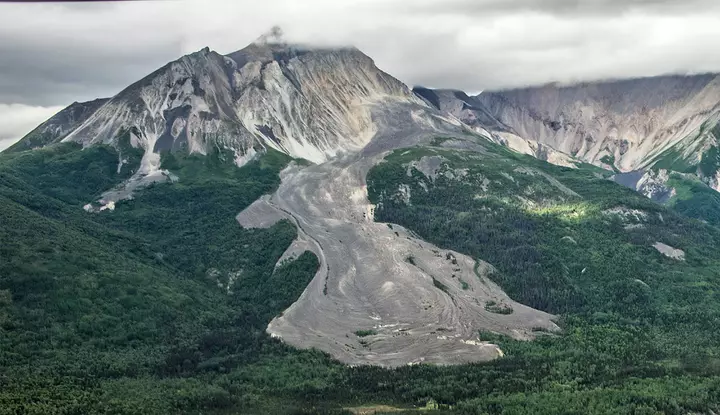
A massive rock glacier flows down from Sourdough Peak in Alaska’s Wrangell-St. As the world’s mountain ice melts, scientists look to the poorly understood rock glaciers to provide temporary reprieve for people and ecosystems Ashlesha Khatiwada was still new to the study of glaciers when she first caught sight of the undulating, rubble-covered slopes of Sourdough Peak rock glacier in Alaska. She recalls flying over alpine peaks, glimpsing what looked like melted lava that had slid down the incline, leaving spectacular rock-strewn lobes, ridges and furrows.
The pattern was that of a classic icy glacier, streaming imperceptibly downhill. Instead, the slow-motion flow appeared to be all rock and dirt. Khatiwada, now an earth sciences PhD student at Colorado State University in Fort Collins, has since learned much more about this strange, easy-to-miss type of glacier.
In recent years, scientists have revealed that such rock glaciers may be important holdouts during a time of rapid melting of the world’s ice reserves. Buffered from rising temperatures by their thick, outer layers of debris, rock glaciers seem to be largely refusing to melt — for now. That’s in stark contrast to the more familiar white, icy type of glacier.
Scientists predict that Earth will lose between 25 percent to more than 40 percent of its glacier mass by 2100, depending on how much the Earth warms. Some estimates suggest that up to 80 percent or more of glaciers could disappear entirely in the same timeframe. Globally, glaciers have lost an estimated 9,500-plus gigatons of ice since 1975 — the equivalent of more than 26 millimeters in sea level rise — with most of the loss happening since 2000.
That’s not counting melting of continental glaciers, or polar ice sheets. This massive loss is expected to dry up crucial freshwater supplies relied on by people and wildlife, and to trigger more natural disasters such as the August 2026 flood that killed more than 1,400 in in Nepal, with thousands more missing. When the long-frozen soil below glaciers melts, carbon and methane gases are released, spurring more warming.
And more ice loss also means even more sea level rise. The relative steadfastness of rock glaciers offers solace to alpine ecologists, who are increasingly concerned about how diminishing water supplies may affect the health of high-mountain ecosystems. Many alpine species, endangered and not, directly or indirectly, rely on consistent flows of cold freshwater to survive — mayflies and stoneflies, salmon and trout, willows and other shrubs, mountain goats, elk and more.
Extract — continue reading at the source.