In A Fine Balance, one of the finest novels about modern India set in the 1960s and 1970s, Rohinton Mistry powerfully conveys a sense of the social meaning of the vote for the Indians at the bottom of the ladder. Narayan, a Dalit tailor, insists on marking his own ballot in an upcoming election instead of allowing an upper-caste landlord’s men to vote on his behalf. Dukhi, his father, warns him against it.
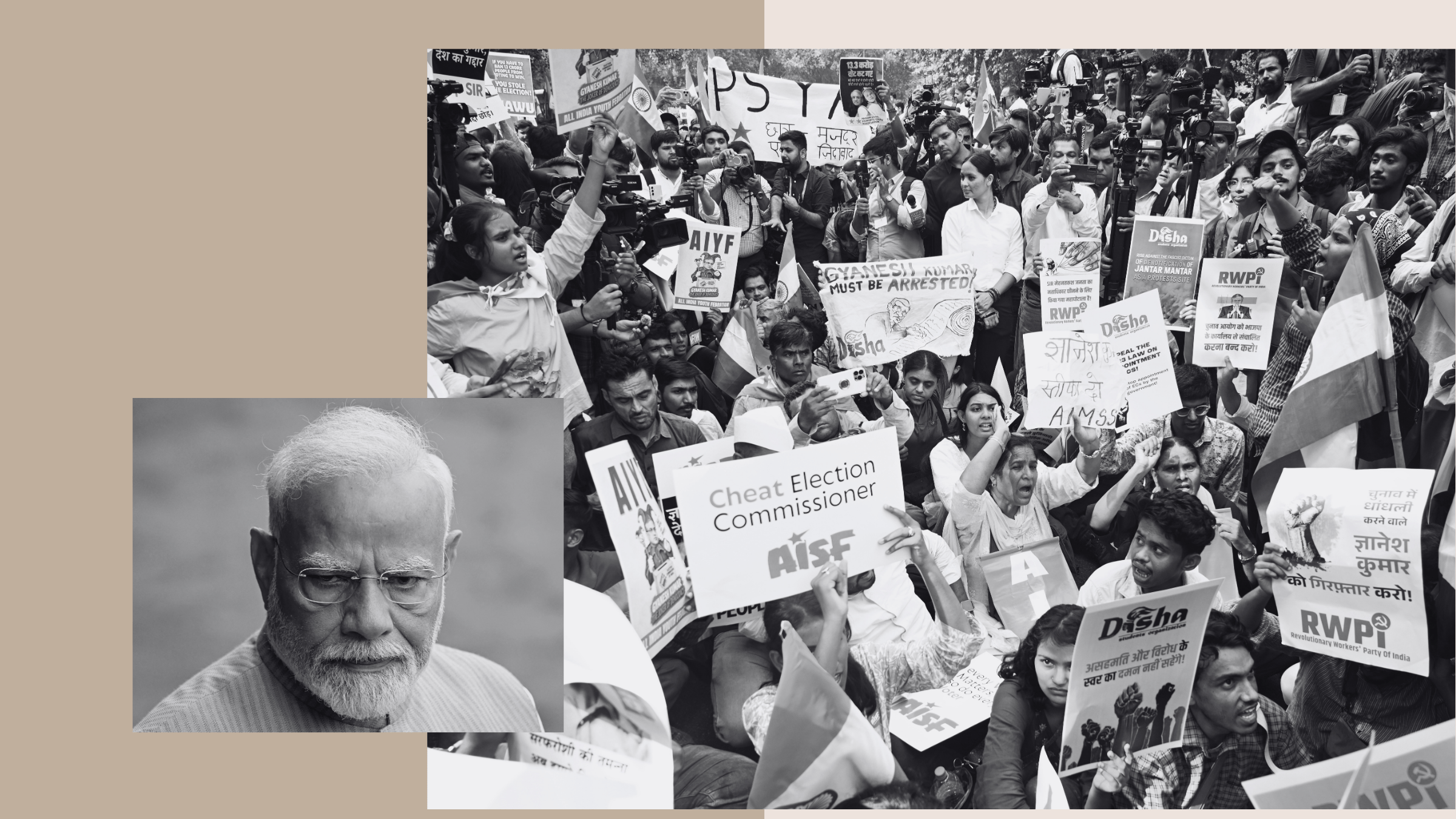
I have been rereading Mistry’s novel over the past few weeks as a series of protests has turned October into a month of fierce battles over the integrity of India’s elections, the accountability of its institutions, the right to protest, and the soul of its democracy. A nascent Gen-Z movement, Cockroach Janta Party, which organized protests over education and unemployment in Delhi in June and July and forced the resignation of India’s higher education minister, gave the call for the October protests. Young protestors answered with an insurrectionary energy in the summer and soon found support from a broader coalition comprised of opposition parties, social movements and other pillars of Indian civil society.
These assorted protesters see the stakes of the current moment as existential: the sanctity of the vote in India, the essential ingredient, in other words, of democracy. Throughout October thousands joined the cause in Delhi and other Indian cities, their marches spurred by anger directed against an ongoing national exercise to overhaul the country’s electoral register. Known as the Special Intensive Revision, the exercise has, according to the protestors, resulted in more than 130 million voters being removed from electoral lists.
Although electoral rolls have been revised periodically, this is the first time such an exercise has placed the burden on citizens to establish their eligibility, raising fears that millions of legitimate voters, particularly the poor and marginalized, could be disenfranchised. Seeking accountability, they have been calling for the resignation of Gyanesh Kumar, the country’s chief election commissioner, who oversees the Election Commission of India, the body charged with conducting and safeguarding the sanctity of elections across the nation. The protestors accuse Kumar of abandoning his constitutional obligation to act impartially.
In their telling, the mandarin has set the table in a way to favor the interests of Prime Minister Narendra Modi’s Bharatiya Janata Party, a charge denied by those in power. Already shaken by the summer protests over education, this time the Indian government responded with coercive force, effectively turning central Delhi, the political and administrative heart of the capital, and the place where India goes to protest, into a garrison. On Oct. 10, it deployed tens of thousands of police and paramilitary personnel, restricted internet access, detained thousands of protesters, and sought to deny the protesters access to public spaces across the capital.
The crackdown was intense. On the night of Oct. 16, there was a palpable sense of panic on social media in India as an urgent question was asked repeatedly: Where is Neha Bora? A 29-year-old doctoral student and left-wing activist, Bora has emerged as one of the most articulate and formidable leaders of these protests, which have rattled Modi’s government and—despite valiant attempts to construct a counter narrative by BJP leaders and other party apparatchiks—become a significant challenge to his popularity and legitimacy.
Extract — continue reading at the source.