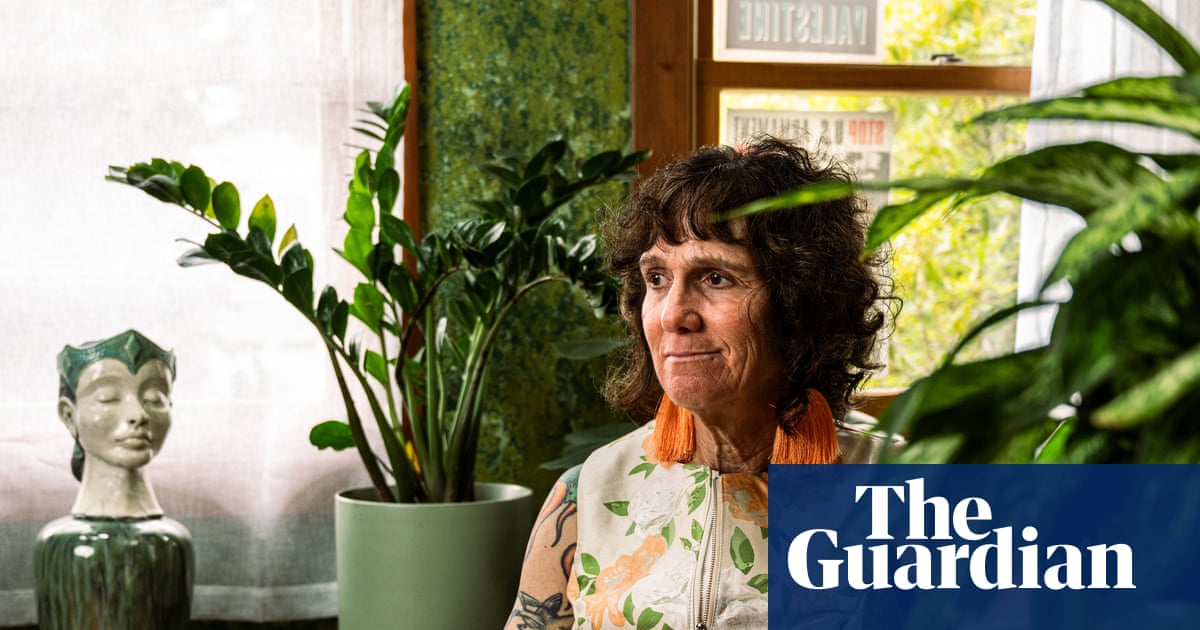
An activist who blocked the entrance to one of the world’s biggest AI companies is believed to have become the first person jailed for protesting against artificial intelligence as supporters dub her the “Rosa Parks of AI risk”. Wynd Kaufman, 69, surrendered herself on Friday to authorities in San Francisco. She was found guilty by a jury for her role in an action last year that saw members of the group StopAI chain and lock the front doors of OpenAI’s headquarters in protest against the pursuit of artificial superintelligence.
The retired teacher from Berkeley, California, refused to move from a sit-in protest in February 2025 and pleaded not guilty to multiple misdemeanor charges. She was convicted in June of interfering with a business, trespassing with intent to interfere with a business, unlawful assembly and refusal to disburse a riot. On Friday, sheriff’s officers handcuffed her as fellow campaigners sang to the tune of the Battle Hymn of the Republic (Glory, Glory Hallelujah): “Rise up, rise up and join us/Do not let the tech bros destroy us.” “It’s absolutely frightening and appalling that these CEOs and AI experts know the dangers and they are pursuing it anyway,” Kaufmyn said before she was imprisoned.
Brooke Jenkins, the San Francisco district attorney, said the guilty verdict sent “a resounding message rejecting the notion that protesters can endanger public safety as a means to an end”. As Kaufmyn was led out from the court, her supporters called out: “Stop AI” and: “Free Wynd” as the sheriff’s officer yelled: “Clear the court” and the judge admonished the protesters. Dwight Ost, 73, one of two dozen other StopAI activists at the courthouse, called Kaufmyn “a brave and courageous woman”.
Since the lobby sit-in last year, some of the biggest AI labs, including OpenAI and Anthropic, have reported their models escaping the confinements of experiments. This week, the US senator Bernie Sanders demanded tech leaders pause AI development, citing fears that, in the wrong hands, it might “lead to new bioweapons that result in the deaths of tens of millions of people”. Meanwhile, more than a thousand researchers at frontier AI labs this summer signed a letter warning of “a real risk that capability development rapidly accelerates beyond our ability to understand or control the resulting systems”.
Frontier AI labs are locked in a race to create more capable AI models as the companies target IPOs that are forecast to reach valuations in the trillions of dollars. At the same time, Washington is competing with Beijing for supremacy in the fast-developing technology, creating a disincentive for tougher safety regulation. Parks was a Black woman who refused to give up her bus seat for a white passenger in contravention of racist segregation laws in 1950s Alabama, a catalyzing incident for the US civil rights movement of the ensuing decade.
Kaufmyn spoke on the eve of her imprisonment from her shingled house in Berkeley, which is festooned with Mexican tiles and pro-Gaza signs. She played down the Parks parallel, pointing out her short sentence, but said the comparison had also crossed the campaign group’s mind, given that she is thought to be the first AI protester jailed. She said that when she was found guilty, she was “hit with a wave of grief” because she realised her peers “just didn’t get” the danger she believes is posed by the race to superintelligence.
Extract — continue reading at the source.