How do news outlets cover war in a region where independent foreign journalists are blocked entry? What to make of the reports of the Israel-Gaza war by the western press in relation to the livestreamed footage on our phones? These are some of the questions that come to mind when thinking about Israel’s actions in Gaza, triggered by Hamas’s attack on 7 October 2023, and bringing apocalyptic brutality and death tolls.
This 90-minute production by British-Romanian collective BÉZNĂ theatre asks many more in its polyphony of satire, song, graphics, snatches of history, absurdism and sincerity. The four-strong cast – comprising Maryam Abu Khaled, Sara Masry, Luca Kamleh Chapman and Sofia – juggle it all in a series of mini lectures, dramatised dialogue, poetic monologues and meta theatre. Written and directed by Sînziana Cojocărescu, it is a production of utmost integrity, centring Palestinian voices, including short excerpts from works by playwrights Ahmed Masoud and Hannah Khalil, and anonymous writings.
They hint at the difficulty in bringing this show to a stage, mentioning two PR companies that shied away. For a play that questions the framing of facts and stories, there is formal innovation around the presentation of these here. But the drama is beached by its own welter of facts and its experimental switches in form.
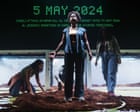
The latter leave you stranded, some scenes so elliptical you are unsure of who is talking and what is happening, with the tone wobbling between plaintive laments, comedy and justified outrage. The trigger warnings, spoken into a microphone, go on for quite a while, and the dramatised material, when it comes, is horrific, such as the report of an Israeli strike first from the point of view of a western marine rescuing a hostage who relays a narrative of squeaky-clean heroism, followed by a report of the same event from the point of view of Palestinian civilians who witness a massacre around them, air-bushed out of the first report. An actor climbs into a glass box beneath the stage, in Jida Akil’s set design (immensely atmospheric, if underused, with mounds of earth) as if hiding from war terror.
We hear the story of a Palestinian man with Down’s syndrome, mauled by an Israeli army dog and locked in a room by IDF soldiers, whose body was found decomposing by his family. These moments are powerful, bringing the play to life, but it is a shame that there is not enough of them and it seems less a drama than a static narration, despite the (sometimes abstruse) movement. A blizzard of facts and figures including the daily death tolls of journalists and of Palestinians are projected on the walls, as well as context that conveys the actions of the Israeli military.
But these come and go in flashes, too fast to absorb or even read. Performers bring verve but are sometimes halting. The overall effect is disjointed and convoluted, with so much hard-hitting material but not enough clear-sighted focus.
Extract — continue reading at the source.