I drove north in the quiet digital bubble of my electric rental car. In 2024, Norway became the first country in the world where electric cars outnumbered petrol cars. A smooth, pristine motorway unfolded between farmlands and low hillsides of dense green forest.
Long tunnels carried the route up above the banks of Lake Mjøsa, Norway’s largest lake. After a little more than an hour, the road curved downward to run parallel to the lakeshore. Through gaps in a line of golden birch trees, a tall, slim structure broke the horizon.
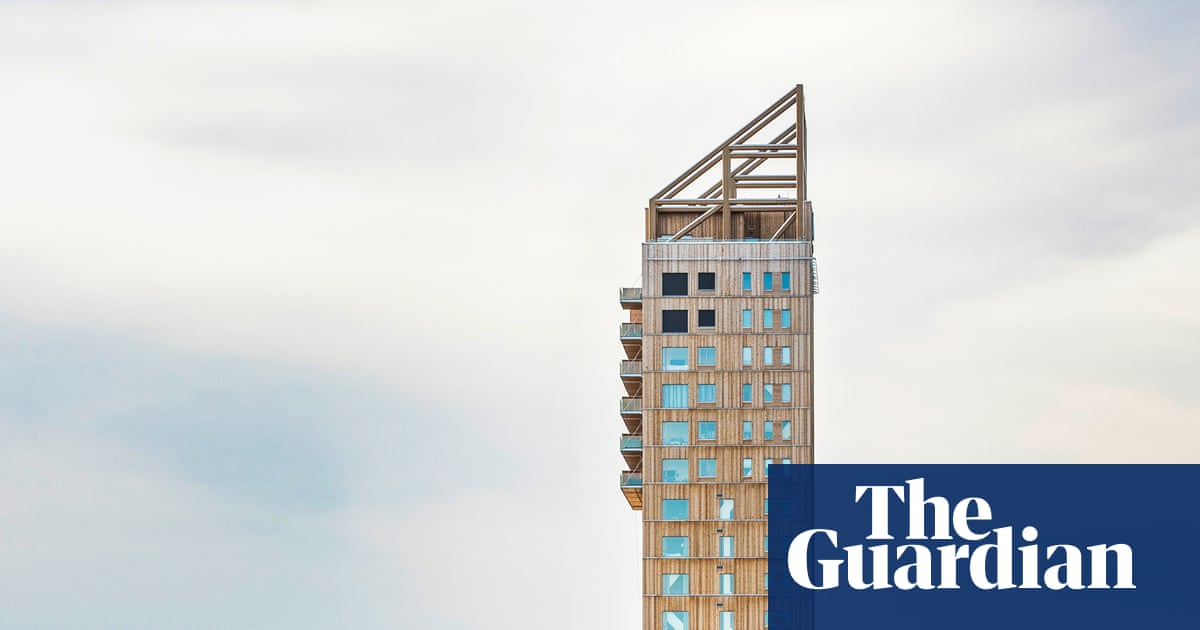
It rose from the water’s edge, topped by a triangular crown of bare, interlocking beams. Against the heavy grey sky and the enfolding mist, it radiated a gentle warmth from its pale burnt-orange exterior. The only building of any height anywhere in the surrounding landscape, it is known as Mjøstårnet, the “Tower of Mjøsa”: an 18-storey, 277ft (84m)-high wooden skyscraper.
The tallest all-timber building in the world. Mjøstårnet occupies a slice of shoreline next to the small town of Brumunddal. It incorporates offices, apartments, and a 72-two-room hotel.
I was staying on the 11th floor, and I rode up in an elevator shaft fabricated entirely of wood (although the elevator cabin itself was made of steel and glass). Two sides of my corner room had large picture windows, one looking west across the lake and the other north along the shore. There were wooden floors throughout, wooden tables and lamps, a wooden bed, and pair of low swivel chairs formed out of thin slats of bent pinewood.
Most striking of all was the huge wooden column that formed both the corner piece of the room and – extending in segments above and below me – one of the four edge-points of the whole tower. It looked reassuringly sturdy, as if it were the trunk of a massive tree that had been stripped of its bark and worked into a smoothed organic approximation of a geometric strut of steel or concrete. Which is almost exactly the case: except that it is not just one tree but many – a series of blocks of timber that are precision cut and then pressed and held together using extremely strong glue, creating what is known as mass timber, or glulam (short for “glued laminated timber”).
Extract — continue reading at the source.