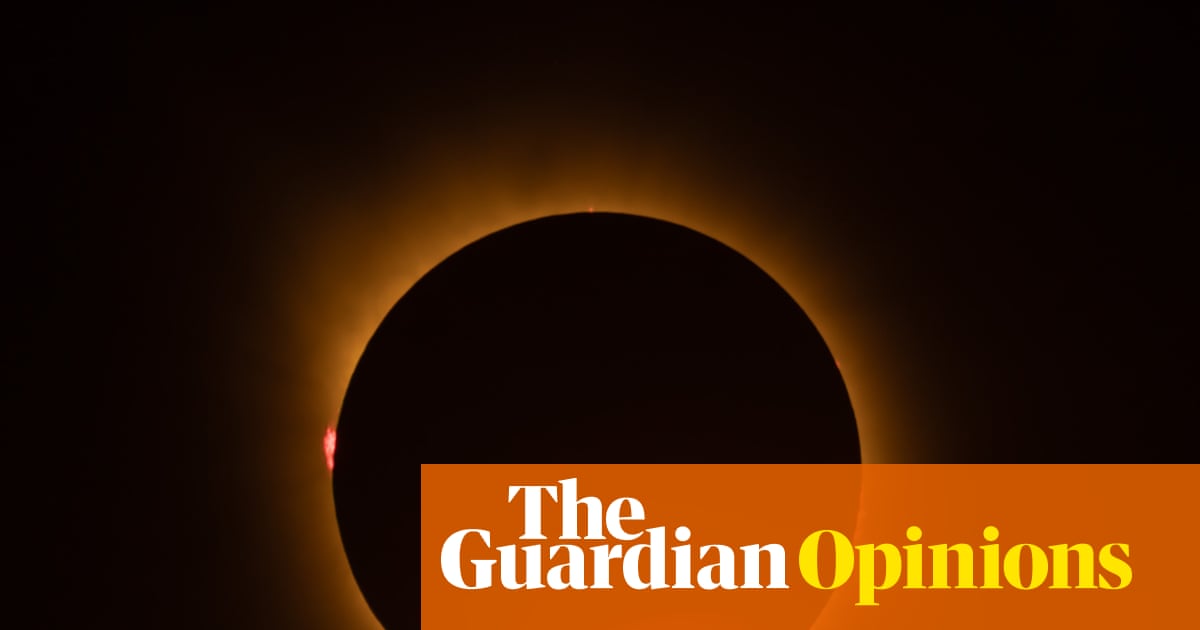
Crowds across the country assembled as the sun’s power seemed to wane, twilight changed tone abruptly, the temperature fell and the familiar landscape took on an unnatural appearance. In a divided world, there is comfort in coming together in awe. Ms Redfern, speaking from Cornwall, was right that Britons “may not see another one.
We have to make the most of these moments.” The country has to wait 55 years for another comparably deep partial eclipse. To experience the true marvel of the eclipse, one had to be in the path of totality – which this week crossed over Greenland, Iceland and Spain. There the sun was completely obscured.
Britain saw a partial version, with the moon covering part of the sun, with only a thin yellow crescent showing. Totality is another world of wonder: for a few minutes a black disc appears where the sun should be, surrounded by a fiery corona in a purplish firmament. It is 64 years before a total eclipse of the sun will be seen over Britain.
Today we understand that eclipses occur when the moon passes directly between the sun and the Earth, a rare three-way alignment known as a syzygy. The moon blocks the sun and casts a shadow across the Earth. As the moon orbits and the Earth rotates beneath it, that shadow races across our planet, tracing a thin ribbon where, for a few extraordinary minutes, day turns suddenly to darkness.
For ancient peoples without such knowledge, something appeared to be eating the sun. In China, the cosmic order appeared threatened by dragons. In India, the disruption was attributed to a demon’s disembodied head.
It was a Greek philosopher, Anaxagoras, who arguably first proposed the correct theory of eclipses after experiencing one in 478BC. Astronomical knowledge became political power most memorably in 1504, when Columbus exploited his knowledge of an approaching lunar eclipse – “blood moon” – to frighten Jamaica’s Indigenous people into giving him food after they had refused. Britain and its empire made a distinctive contribution to understanding the heavens, turning eclipse expeditions into laboratories for the emerging science of astrophysics.
Extract — continue reading at the source.