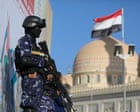
On Saturday, Houthi rebels launched a shocking and deadly attack on Saudi Arabia’s capital city, Riyadh. At the time of writing, the missile strike on King Khalid international airport has killed at least 13 people and left 300 injured, marking a significant turn in a regional conflagration that is only getting more intense. It was the single most deadly attack on any Gulf country since the US and Israel launched their war on Iran in February.
In Saudi Arabia, a country that is unaccustomed to such fatalities, the death toll is bewilderingly high and likely to prompt a bloody response. Over the past year, the Gulf has entered a new era of instability that is not temporary and cannot be reversed. This may feel like an overstatement – casualties have been relatively low, after all, compared with Gaza and Iran – but the gradual erosion of peace and security in places such as Saudi Arabia, Qatar and the UAE has changed the region more dramatically than its leaders would like to acknowledge.
The first audacious and unthinkable thing happened just over a year ago, when Iran fired missiles at an airbase in Qatar that hosts American troops, in retaliation for US strikes on Iranian nuclear facilities. Lighting up Doha’s skies and scattering shrapnel, it was a dismaying moment for the Qataris, who have tried to maintain good relations with Iran. But even then there was a degree of warning and coordination that signalled this was a face-saving measure on the part of the Iranians.
Yet later in 2025, with no similar warning or choreography, Israel struck Doha, targeting Hamas members and killing five Palestinians and one Qatari. That was the beginning of the end of a longstanding norm and expectation – that there was a sanctity to Gulf lives and sovereignty, one secured by the management of the relationship with Iran and alliances with the US. Then came Donald Trump and Benjamin Netanyahu’s war on Iran, which drew the Gulf once and for all into the fray.
In retaliation for what Iran perceives to be political, military and logistical support for the offensive against it, Tehran struck Saudi Arabia, Qatar, the UAE, Bahrain, Kuwait and Oman. Iran targeted military sites, energy facilities, desalination plants – an entire infrastructure that underpins the economies of these countries. Much damage was inflicted by the suspension of normal life, the shuttering of schools for months, the closure of airports and airspace.
The most disastrous consequence of all, from the perspective of Gulf rulers, has been the way the attacks have disrupted the integration of these countries into the cosmopolitan international community as places for tourism, entrepreneurs, sports and entertainment. They spent billions in securing Formula One, golf and boxing franchises and tournaments, only for a flurry of cheap drones to put it all at risk. The result is a fractious unravelling that has reactivated hostilities that had laid dormant.
Extract — continue reading at the source.