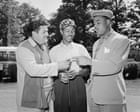
At the 1948 US Open, he finished the first round just three shots behind the leader – and eventual winner – Ben Hogan. But there’s more to the story: Rhodes was the first Black competitor in the tournament in its modern era, during a time of widespread segregation in American sport. Rhodes is the subject of a new book by sports historian Dan Taylor, Out of the Rough: Ted Rhodes and His Fight against Golf’s Color Barrier.
The author aims to change what he sees as mainstream unfamiliarity with Rhodes, even among golf enthusiasts. I found his story quite remarkable, his success absolutely amazing, what he accomplished to be quite inspiring.” The author of multiple books about sports, mostly baseball, Taylor was also an award-winning sportscaster in his home town of Fresno, California. You can hear the broadcaster in his voice – and you can sense his enthusiasm when he talks about Rhodes.
Taylor sees Rhodes as part of a throughline of achievement for Black golfers that extends to Rhodes’s protege, Lee Elder, as well as Tiger Woods. The book notes that when Woods won the Masters at age 21 in 1997, he gave a speech honoring Black trailblazers in golf, including Rhodes. He had pain and medical problems, but was still successful.” And, Taylor adds, “he was a fun person, very fashion-oriented.
He loved to be very fashionable out on the golf course. GQ ranked him the third-best-dressed golfer all-time. He had mink club heads.” In addition to reintegrating the US Open, Rhodes was part of a 1948 lawsuit against the PGA, which had restricted membership to white people.
The PGA responded with a settlement and a promise to change, but according to the book, instead it shifted the status of tournaments from open to invitational, allowing the organization to tacitly continue segregation. A high percentage of the schedule was in the 17 Jim Crow states. Country clubs, for the most part, did not permit persons of color to play.
The PGA had a very firm caucasian-only membership policy.” After the lawsuit, and the tournaments’ new status as invitationals, “to be invited to play, you had to be a member of the PGA,” Taylor says. You could not play enough events, win enough points or prize money. He adds, “It’s unbelievable to me that … Jackie Robinson integrated pro baseball and Kenny Washington integrated the NFL [in the late 1940s, yet] it was not until 1962 that the PGA changed their membership policy.” Before the PGA reversed its stance, some courses welcomed Black players for PGA events, including Phoenix Country Club for the 1952 Phoenix Open, where the Black entrants included Rhodes and a crucial figure in his life: boxing great Joe Louis.
Extract — continue reading at the source.