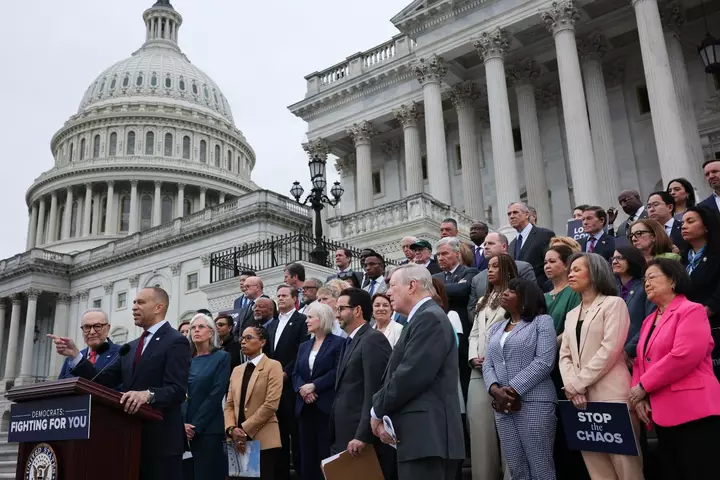
The court-stalled implementation of a new congressional map in Missouri has for months placed a question mark over the state's upcoming elections. Despite a recent decision from the Supreme Court, some doubts still linger, days out from Election Day. Last year, President Donald Trump urged Republicans across the U.S. to redraw their congressional maps to favor the GOP.
Missouri’s Republican-led legislature joined historically red states such as Texas and North Carolina—but also Democrat states like California—in doing so. This resulted in major changes for the Kansas City area in particular. Missouri’s secretary of state rejected efforts to pause this change long enough for the August primary to take place using the new map.
Afterwards, the Eighth Circuit held that switching maps for the general election would be a violation of both federal law and the Constitution. However, the Supreme Court has stayed this judgment and ruled that the midterm elections will proceed with the boundaries of the 2022 map, despite candidates having been chosen under the 2025 version. "Regardless of what this court does," the state’s Solicitor General Lou Capozzi wrote ahead of the decision on September 25, "Missouri will not be able to run an orderly 2026 general election." In its ruling, the Supreme Court said that the 2025 map had not yet taken effect due to the nature of Missouri’s referendum process for such changes.
It also underscored the fact that voting was underway, and that the older map was already effectively governing the election. "The election is not merely upcoming; it has already started," the ruling read. "Ballots using the 2022 map have been printed and mailed.
Absentee voting has already begun, as has military and overseas voting." Citing estimates that came up during the court cases, Jeffery Jenkins, professor of Public Policy, Political Science, and Law at the University of Southern California, told Newsweek the differences in the maps used for the primary and general election means around 1.4 million Missourians have changed districts. Around 284,000 primary voters will now be voting in a different district, he added. The Missouri Independent said voters across 28 counties are in this situation, though Jenkins said this was only likely to impact the results in the Kansas City-based Fifth District in Democrats’ favor.
"The likeliest outcome therefore shifts from a possible 7-1 Republican delegation to the existing 6-2 split," he said, "which is potentially important if House control is close." The decision settled the immediate question of which map would be used for the 2026 election. To some, however, the stay decision has failed to address the underlying legal dispute. Close results, voter-district disputes or a contested outcome for the redistricting referendum—also taking place November 3—could revive legal disputes and disagreements between the courts.
Extract — continue reading at the source.