This pummelling Netflix production seeks pathos amid the gunfire as it tells the true story of four college football stars joining the Marines in the wake of Pearl Harbor, but not one of these noble warriors feels like a real person. No one familiar with the oeuvre of Peter Berg — the action merchant behind the Afghanistan war drama “Lone Survivor” and the improbably pumped-up boardgame adaptation “Battleship” — should approach “The Mosquito Bowl” expecting great restraint or good taste. Ostensibly, Berg’s Netflix-backed combat epic is fighting the same fight as Terrence Malick’s “The Thin Red Line,” likewise charting the physical and psychological torment of American soldiers in Guadalcanal during the Pacific Theater of the Second World War.
But they are two very different history lessons. There’s not a hint of Malick’s poetic anti-war melancholy in Berg’s brawny, cacophonous Semper Fi salute to American military brotherhood, which certainly doesn’t stray from standard war-is-hell sentiment — rarely, in fact, has war been depicted as more loudly ruinous — but positively revels in onscreen carnage, as if to underline the mettle of its Marine heroes. Not that said mettle is in any danger of going unnoticed.
For the four men at the pretty hollow center of “The Mosquito Bowl” aren’t just soldiers but sportsmen — stars of the college football circuit who bring their strength and smarts from the field to the battlefield. And if that comparison sounds glib to you, then buckle up, because the film has plenty more: “The Marine Corps is the greatest offensive line in the history of football,” says one character, a sentiment that sounds sort of rousing without making much sense. That goes for much of the script by Berg and Mark L.
Smith, which is drawn from a popular 2022 historical novel by Buzz Bissinger — the journalist whose 1990 bestseller “Friday Night Lights” became the basis of Berg’s sturdy 2004 football drama and the more popular TV series spun off from it. Berg and Bissinger are cousins; the screen adaptation of “The Mosquito Bowl” was likely a fait accompli all along. Yet while the book’s ennobling mixture of Greatest Generation portraiture and brutal evocation of the rigors of combat is perfectly tailored to the filmmaker’s interests, it also hands the screenwriters a bit of a structural red herring.
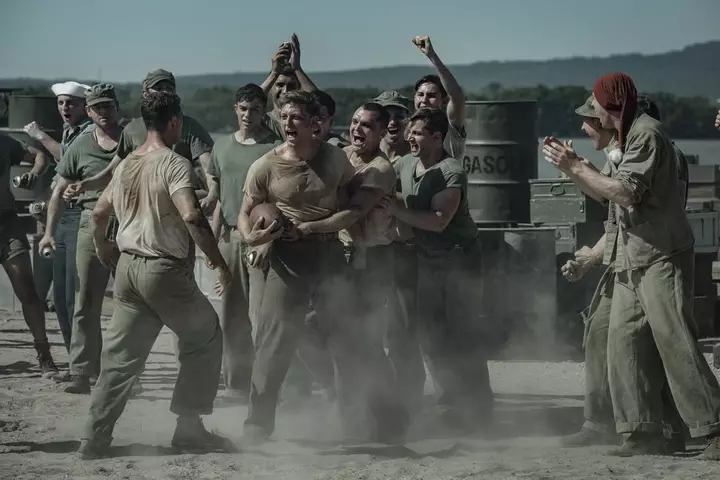
The title refers to a football game that the principals were tasked with organizing on Guadalcanal; it was played on Christmas Eve 1944 between the 4th and 29th regiments of the 6th Marine Division, and featured a wealth of drafted football talents who had set aside their sporting careers to serve their country. Outwardly, the book and film both seek to imbue this event with the significance of the famed Christmas truce soccer matches between British and German forces in the no-man’s-land of the First World War. When push comes to shove, however, the game simply isn’t all that consequential.
It’s skipped over surprisingly swiftly on the page, and despite much anticipatory buildup, the film, too, struggles to make a climactic set-piece of an event that has considerably less visceral impact than the various juddering, blood-on-the-lens battle scenes on either side of it. Nor does it work as a human interlude, because the human dimension of “The Mosquito Bowl” is so flimsy. Its four principals are colorless, interchangeable alpha males, uniformly stout of build and square of jaw; they’re granted mildly differing character attributes by the script, but even as the closing credits roll, you’d be hard pressed to remember who was who.
Extract — continue reading at the source.