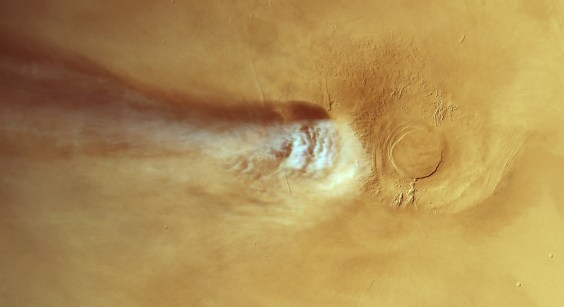
If you ever get a chance to stand at the foot of the giant Arsia Mons volcano on Mars during spring or summer dusty season, you’ll witness one of the solar system’s most spectacular sights around dawn: the dramatic appearance of the Arsia Mons Elongated Cloud (AMEC). First, a cloud forms overhead, caused by air getting pushed up the sides of the volcano, where scant amounts of water vapor in the atmosphere freezes. Then, it forms a trail that pushes out across the expanse of the sky, driven by winds up to 373 miles per hour.
Read more: “The New Seismic Discovery Beneath the Surface of Mars” The scales are vast. Arsia Mons is more than twice the height of Mount Everest, and the ice cloud stretches almost 1,120 miles—or about one-and-a-half times the length of California. Then, in a few hours, as the sun rises and the air warms, it’s gone, only to reappear again like clockwork the next morning.
Of course, we can’t observe the AMEC from the ground yet, but the Mars Express probe has been watching it closely from orbit since 2018, and researchers have now discovered that this incredible meteorological phenomenon involves some pretty unusual physics. A new study has managed to find a simulation model that fits the AMEC, and it removes an element that’s typically essential for formation of these types of clouds. Such orographic clouds are found on Earth too, but they usually require some kind of particles for the ice to cling on to—salt, pollen, soot, or dust, for example.
With the AMEC, it was thought that dust was acting as an ice crystal carrier. The latest hypothesis, however, is that the ice forms all by itself. It’s akin to droplets of condensation appearing in the middle of a room, rather than on a window.” Technically it’s known as homogeneous nucleation, and it’s the first time it’s been seen in a planetary atmosphere, with the researchers describing it as “wholly unexpected.” Physics can explain it, but only via an exotic level previously theorized rather than observed, and reliant on very rare circumstances.
To that end, the researchers think the height of Arsia Mons, the thinness of the atmosphere, and the extreme relative humidity—potentially more than 100,000 times more than what is typical on Earth—all combine to produce the required very rare circumstances. That said, while the new model is the best one yet for AMEC, there are still unexplained discrepancies. It’s a reminder that other planets have events that are genuinely out of this world.
Subscribe to our free newsletter.
Extract — continue reading at the source.



/https://tf-cmsv2-smithsonianmag-media.s3.amazonaws.com/filer_public/55/9c/559c3e43-f760-48c8-978b-1faec1bf964e/nobel-chem.jpg)