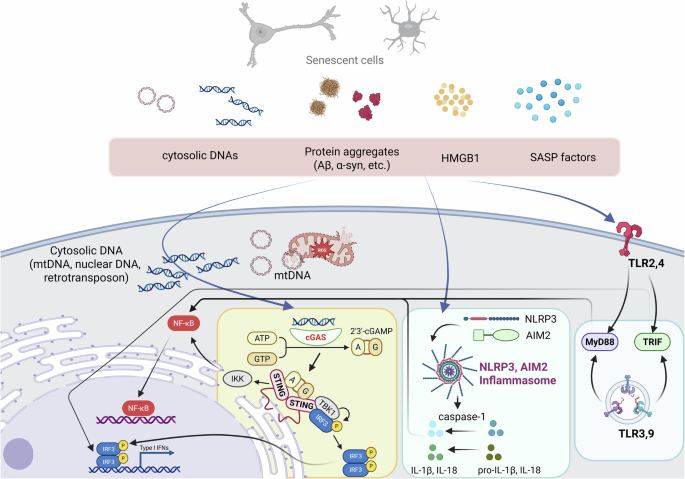
Ageing is the strongest risk factor, accompanied by a chronic, mild inflammatory state called ‘inflammaging,’ partly due to senescent cells producing senescence-associated secretory phenotype (SASP) factors. Innate immune DNA- and danger-sensing pathways, most notably the cyclic GMP-AMP synthase–stimulator of interferon genes (cGAS–STING) pathway and NOD-like receptor family, pyrin domain containing 3 (NLRP3) inflammasomes, convert cellular injury into chronic neuroinflammation. Here, we propose that protein pathology, SASP, and innate immune activation form a self-amplifying triangular circuit leading to age-related neurodegeneration.
We present the cellular and molecular basis of each part and how microglia, astrocytes, oligodendrocyte precursor cells and neurons contribute. We outline treatment strategies, including senolytics, senomorphics, innate immune pathway inhibitors and metabolic restoration, and identify unresolved questions, including the reversibility of post-mitotic neuronal senescence, the relative contribution of each cell type and the translational challenge of interrupting the cycle. Collectively, the neuro-inflammaging triangle theory shifts focus from individual pathogenic entities to the self-amplifying circuit that sustains them, offering a unified mechanistic model to advance our understanding and treatment of age-related neurodegeneration.
Neurodegenerative diseases (NDs) are chronic disorders characterized by progressive neuronal loss, abnormal protein aggregation and neuroinflammation. In Alzheimer’s disease (AD), extracellular amyloid β (Aβ) plaques and intracellular neurofibrillary tangles of hyperphosphorylated tau are the defining lesions1,2. In Parkinson’s disease (PD) and other synucleinopathies, α-synuclein aggregates are found in neurons and glia3,4,5, whereas amyotrophic lateral sclerosis (ALS) and frontotemporal dementia (FTD) feature TDP-43 inclusions6.
These aggregates propagate to anatomically connected brain regions as the disease progresses7,8. Ageing is the strongest risk factor for virtually all NDs. The aged brain accumulates senescent cells and protein aggregates while displaying chronic low-grade inflammation9,10,11.
This age-associated chronic systemic inflammatory state, called ‘inflammagingʼ12, is now recognized as a major contributor to cardiovascular and metabolic disease, as well as NDs13,14. Cellular senescence significantly contributes to inflammaging. It is characterized by stable cell-cycle arrest, apoptosis resistance and secretion of proinflammatory senescence-associated secretory phenotype (SASP) factors17,18,19.
Through SASP factors, senescent cells can propagate senescence to neighbouring cells, a phenomenon recognized as the senescence ‘bystander effectʼ or senescence-induced senescence, creating a self-reinforcing inflammatory microenvironment20,21. In the ageing brain, senescence and senescence-like phenotypes have been described in neurons, astrocytes, microglia, oligodendrocyte progenitor cells and brain endothelial cells, which display distinct phenotypes22,23,24. DNA- and danger-sensing pathways in the innate immune system have recently emerged as central regulators of inflammaging.
Extract — continue reading at the source.