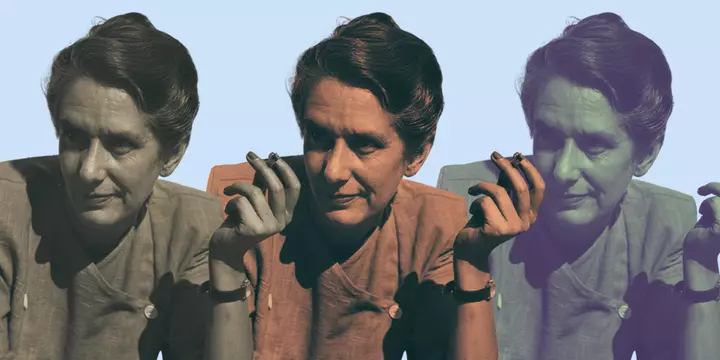
Erika Mann drove through the night to meet the fifty-two most wanted men in the world. It was the middle of August 1945 and she was a few weeks shy of her fortieth birthday. Streaks of gray were beginning to show in her short brown hair.
She gripped the steering wheel with gloved hands, only raising them to light cigarette after cigarette, which she smoked out of the corner of her mouth. She was thin but far from frail in her signature attire of trousers and flat, practical shoes. As night swallowed up the road ahead, her dark eyes had a singular intensity of focus.
The previous afternoon in Paris, Mann had been commissioned by London’s Evening Standard to write a story that would start to make sense of over a decade of suffering. The eldest daughter of Nobel Prize–winning author Thomas Mann, Erika was a writer and performer of rare commitment. She had staged an anti-Nazi cabaret in Munich in 1933 and broadcast for the BBC since 1940.
Mann was attached to the Allied forces from 1943 onward and accompanied them as they swept toward Germany. Even before that she was a veteran reporter of conflict, having gone to Spain in 1938 to cover the civil war for the New York–based German-language newspaper Neue Volks-Zeitung. Could she face the monsters who had degraded her family and shattered her country?
Her qualifications for her current mission were not merely professional. Erika had been living in exile in Europe and the United States with her family since 1933, when they escaped Munich for the safety of Zurich in the wake of Hitler’s election as chancellor. The Manns were subsequently declared enemies of the state and in 1935 stripped of their German citizenship.
Now she was finally in a position to confront and expose the men she had spent years denouncing. In the blue predawn light, she made out a string of factories, blast furnaces, and workers’ barracks. She was now in Luxembourg.
Extract — continue reading at the source.