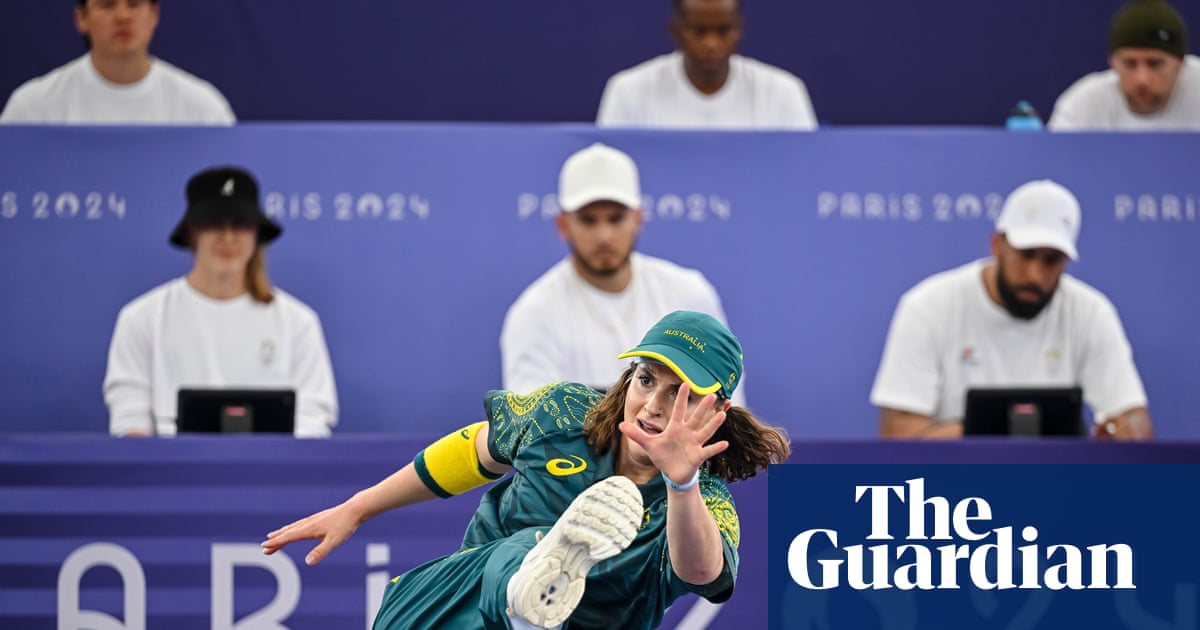
Early in Netflix’s new documentary, Untold Raygun: Breaking Badly, Australian B-girl Rachael Gunn, recounts a session she had with her sports psychologist prior to the 2024 Paris Olympics. Her therapist asked her what was the worst thing that could happen. And she said, “The whole world could laugh at me.” Her therapist responded: “Do you think that’s reasonable?” Cue Gunn’s hysterical laughter.
Anyone who has ever gone to a therapist will be amused at this anecdote. Nine and a half times out 10, the therapist would have been right. No, they’d say, the worst outcome you can imagine probably won’t come to pass.
But in Gunn’s case, what she feared the most did, in fact, happen. Her shenanigans – the sprinkler, the kangaroo hops – in the cypher made her go viral almost as soon as she was done with her sets. (Perhaps if Gunn had been explicit about what she was planning to do in her sets, her therapist would have reacted differently.) Gunn’s performance launched a thousand memes, more than a couple of late-night TV segments, several conspiracy theories, and even a musical at the Edinburgh Fringe Festival. All without winning a single vote from any of the nine judges across her six rounds.
Untold Raygun, which premieres globally on Netflix on Tuesday, really doesn’t dwell on what it means for breaking, an art form created by Black and Brown youth in the South Bronx, that its first Olympic foray will be primarily – if not exclusively – remembered for a white woman from Australia doing the sprinkler instead of the dynamic performances of the rest of the contenders. It’s mostly focused on Gunn herself with little time spent on the greater context of the art form and how it ended up in the Olympics. The documentary features interviews with Gunn, her parents, her husband who introduced her to breaking, and a few dancers who know her from the Aussie scene.
Through them, we get a coming of almost middle-age story about an academic who meets a B-boy working at a call center, falls in love with him and the art form he’s passionate about, and somehow ends up centerstage at the Olympics. Gunn is likeable in the documentary. She comes across as (mostly) self-aware and self-deprecating.
Her parents are charming, laughing heartily when asked if they had ever previously associated “Olympian” with their quirky daughter. Sammy Free seems like a sweet fellow who is completely besotted with his wife. (We should all be so lucky to find someone who loves us the way that Free clearly loves Gunn.) But the most useful voices in Untold Raygun are the two Australian B-girls who offer some critical perspective on the place of women in the breaking scene and Gunn’s performances at the Games. They’re harsh, at times, but also fair.
Extract — continue reading at the source.