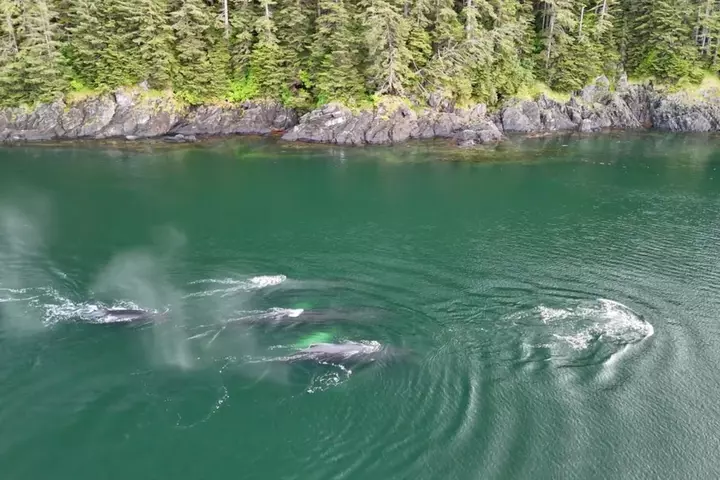
A pod of humpback whales making its way through Alaska’s Inside Passage. Courtesy of Far North Footage/Getty Images The French naturalist Jean-Baptiste Lamarck was 65 when his great treatise on the transformation of life was published. With Philosophie zoologique (1809), translated a century later as Zoological Philosophy, Lamarck intended to establish an entirely new science, one built on the idea that all living beings are constantly transforming themselves, from the tiniest microbes to the most complex mammals, gaining new forms and new abilities.
It wasn’t the bodily structures of organisms that determined their ways of life, Lamarck said, but just the opposite: their ways of life in response to their circumstances gave rise to their changing bodily forms. Lamarck suggested that, by stretching to reach leaves in high tree branches, giraffes slightly elongated their necks, creating tiny changes that were then handed down to their offspring, accumulating over many generations to produce the long necks we see today. Around the turn of the 20th century, Lamarck’s giraffe idea became a laughing stock when biologists roundly rejected the notion that bodily changes undergone in the course of an individual lifetime could be inherited in the next generation.
It wasn’t only his ideas about long-necked mammals that came under attack. Lamarck’s interest in giraffes was just a passing mention in the midst of his voluminous writings, which set out a revolutionary, field-founding theory: organisms, he claimed, transform themselves and, in doing so, they remake the world. That idea has drawn scorn for more than two centuries.
Though Lamarck is often overlooked, his science was foundational to modern biology and informed the theory of evolution that Charles Darwin later developed. Darwin followed Lamarck in believing in the agency of living beings to transform themselves and their environment. But most people don’t know about Lamarck’s influence on Darwin because, around the turn of the 20th century, Darwin’s followers expurgated every trace of Lamarckism from their neo-Darwinist version of evolution, rendering living beings the objects of random variation and outside forces.
For the neo-Darwinists, living things played no direct role in the evolutionary process. Evolution happened through random genetic variation and external environmental pressures. For Darwin’s followers, organisms were just as passive as they had been for the creationists, who saw them as products of divine will.
Throughout the history of modern biology, most powerful figures in science and politics have ridiculed and repressed Lamarck’s radical idea that organisms have agency in the evolutionary process. In mainstream biology today, a neo-Darwinian view of living things as passive still largely dominates, though research in several areas has been challenging its reign. This is the story of how Lamarck’s radical idea was cast aside by mainstream science, and why it was overlooked for so long.
Extract — continue reading at the source.