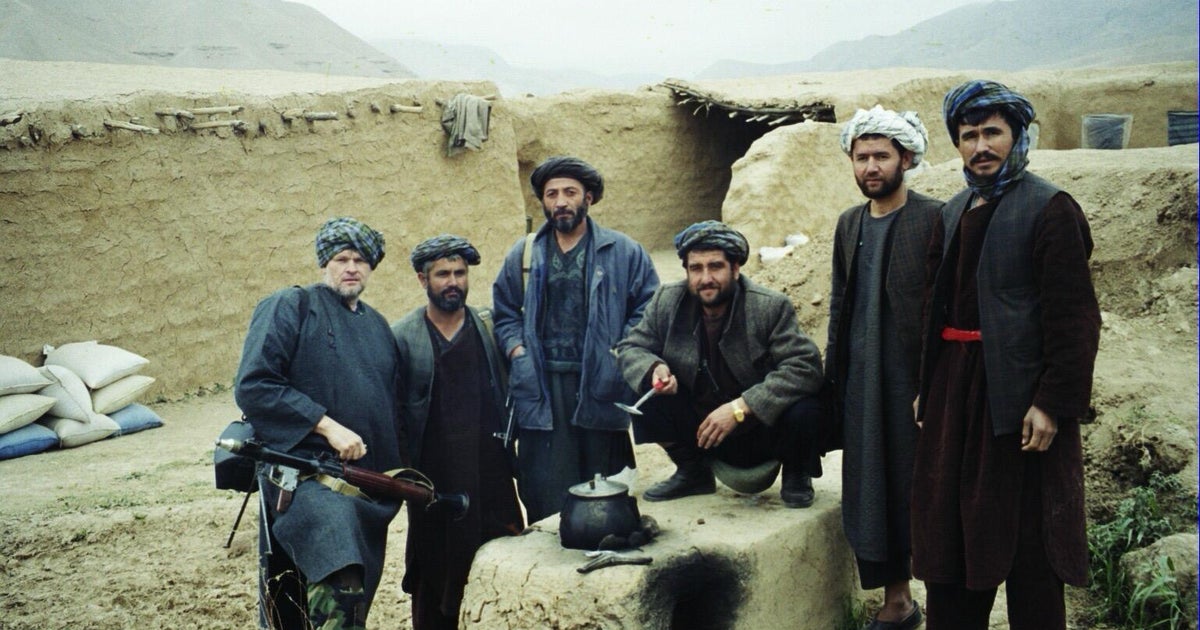
Twenty-five years ago, a Soviet-designed helicopter crossed the mountains of Afghanistan carrying the first CIA officers sent into the country after the attacks on Sept. 11, 2001, marking the opening move in the U.S. response that would soon become America's longest war. The seven-man CIA team, code-named JAWBREAKER, landed in the Panjshir Valley on Sept. 26, 2001, just 15 days after the attacks, carrying millions of dollars in cash intended to help enlist and equip Afghan allies. Their mission was to gather intelligence and prepare the ground for the looming U.S. campaign against al-Qaeda and the Taliban — including by shoring up ties with the Northern Alliance, whose military leader, Ahmad Shah Massoud, had been assassinated by al-Qaeda operatives just two days before 9/11.
The Mi-17 that carried them there is now on display at CIA headquarters in Langley, Virginia, where it has undergone an extensive restoration ahead of the anniversary. Former CIA officer David Tyson followed JAWBREAKER into Afghanistan weeks later as a member of Team Alpha, and remembers flying aboard the same aircraft before the war. "It was shaking a lot, fuel was leaking, very noisy, and I didn't know if it was airworthy," Tyson told CBS News in an interview, "but I was assured by the pilots it was a good bird." The CIA acquired the Mi-17 in the 1990s, calculating that its Soviet origins would be an advantage in the region.
"The Northern Alliance and the Taliban both used Mi-17s," CIA historian Rob Byer told CBS News. "They're Russian helicopters and kind of the pickup truck of helicopters in that region." "The big reason we got an Mi-17 rather than flying in a Blackhawk is because it blends in," Byer said. "And when you're going behind enemy lines, you'd like to blend in as much as you can." It could also handle the punishing altitude.
To reach the Panjshir Valley, JAWBREAKER had to cross the Anjuman Pass, which rises roughly 14,500 feet above sea level. "The Mi-17 is one of the few helicopters that can actually make it over that pass," Byer said. The aircraft had no transponder to identify it to American warplanes, leaving its crew to improvise.
They painted "USA" and an American flag across the tops of its stabilizers, visible to friendly pilots overhead but concealed from enemy eyes on the ground. With no blue paint available, the crew left the flag unfinished. And in a reminder of the attacks that had brought them there, they gave the helicopter the call sign "9-11-01." The Mi-17 would go on to fly more than 300 missions in Afghanistan, remaining in service until 2012.
Tyson was a CIA case officer based in Central Asia who was steeped in local languages, including Uzbek, Turkmen and Russian. On Sept. 11, 2001, he was on a flight to the United Kingdom for a meeting related to the CIA's efforts to recover Stinger missiles that had remained in Afghanistan, many of which were sent there in a U.S.-backed initiative during the Soviet war. Soon after he landed, he began planning his return, realizing his expertise would likely take him to Afghanistan.
Extract — continue reading at the source.