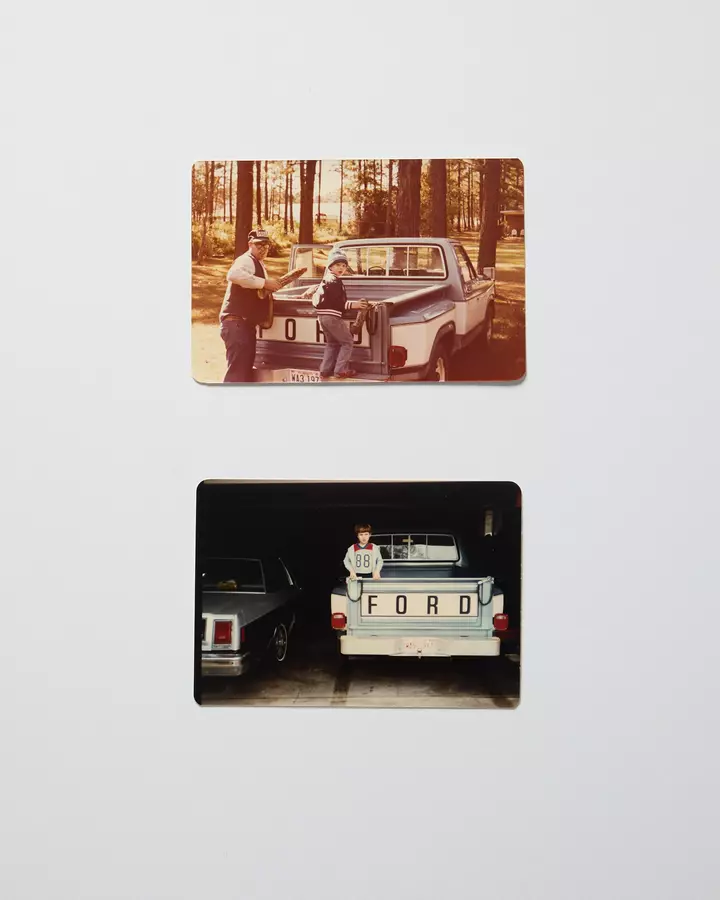
I lived in the same house from the time I was a small child until I was eighteen years old, but I never noticed the two battered shoeboxes that my father kept in a white wooden cabinet in his bedroom. My parents’ TV sat right in the middle of the built-in shelving. Above it were albums full of family photographs and my dad’s family Bible.
Below it were two open-door cabinets. Every child knows there is a zone of privacy in their parents’ bedroom, a place where they keep things that don’t concern you, that pre-date you. But I wonder, knowing what I know now, if it’s also the case that some things can’t be found until a person is ready to find them.
It was September 2022, when I was forty-four years old and my father, Victor Plohetski, was seventy-eight, that he told me about the shoeboxes. I arrived at his house—my house, the one I grew up in—and began what was, at that point, becoming our ritual. I met him in the living room in his oversize recliner, a chair he rarely left anymore.
I unpacked my recorder and turned it on. I pulled out a yellow legal pad. I composed the questions I wanted to ask.
I am a journalist by training, a journalist in my soul the way my father was a roughneck. For a month, I had been interviewing him, determined to understand more about his life. I wanted to answer a question that had plagued me since I was a boy: Why had there been such an unclosable distance between us?
I grew up in Tylertown, Mississippi, a small dot on the state map with about nineteen hundred people and one stoplight, and spent most of my childhood on forty acres just south of town. I am gay, and as a child I was eager for people to like me, mostly because in that time and place being gay often led to taunts, ridicule, or worse. I remember adults—teachers, friends’ mothers, others in our town—using the same word to describe me: tenderhearted.
Extract — continue reading at the source.