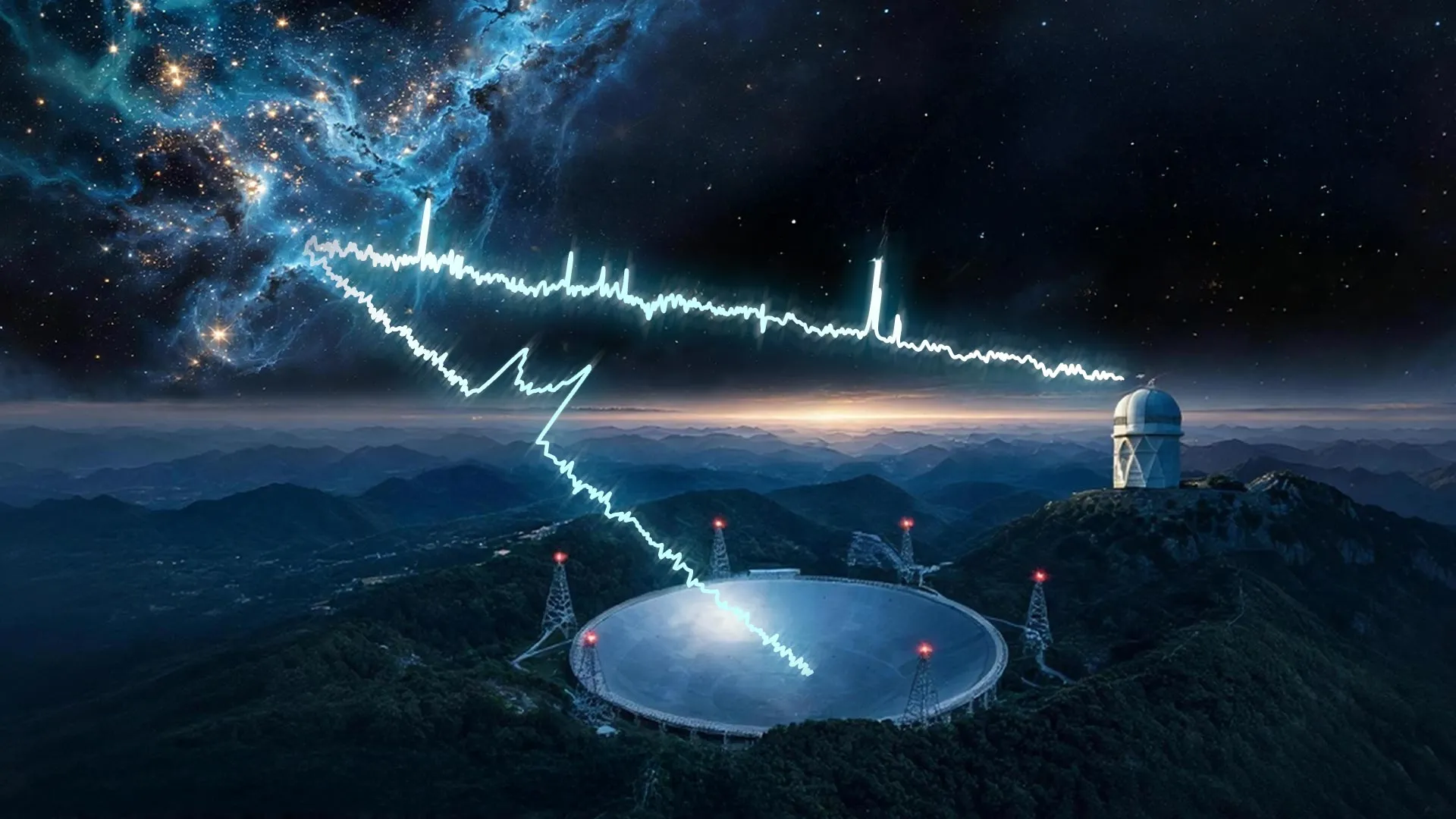
The universe is producing fewer stellar "babies." Over the past 4.5 billion years, the rate at which new stars form has fallen to less than half its previous level. Yet the supply of one of the most important types of "fuel" for star formation has changed surprisingly little. That finding comes from an international research team led by scientists from the Chinese Academy of Sciences (CAS), working with the Dark Energy Spectroscopic Instrument (DESI) project.
Using China's Five hundred meter Aperture Spherical radio Telescope (FAST), the researchers made precise measurements of cosmic neutral atomic hydrogen across the past 4.5 billion years. Their results show a striking mismatch. Star formation has declined sharply, while the amount of neutral atomic hydrogen (HI), an important reservoir of gas within galaxies, has decreased only modestly.
The findings were published online in Nature Astronomy on Sept. 1. Understanding why star formation has become less active as the universe ages is a major question in research on galaxy formation and evolution. One seemingly straightforward explanation is that galaxies have gradually consumed the cold gas needed to produce stars.
If dwindling supplies of cold gas were primarily responsible, however, astronomers would expect the dramatic fall in star formation to be accompanied by a similarly large decline in the available gas. So far, observations have not shown such a sharp depletion. HI plays a central role in this puzzle.
It is an important cold gas reservoir inside galaxies, connecting the broader cosmic supply of gas with the processes that eventually produce new stars. Astronomers primarily detect HI through its extremely faint 21-centimeter radio emission line. Detecting that signal from distant galaxies is difficult because it is often overwhelmed by background noise.
FAST and DESI Survey Millions of Galaxies For years, astronomers faced a major observational challenge. Very deep surveys could achieve the necessary sensitivity but could not examine large regions of the sky. Surveys covering much larger areas, meanwhile, generally lacked the sensitivity needed to detect such faint radio signals.
Extract — continue reading at the source.