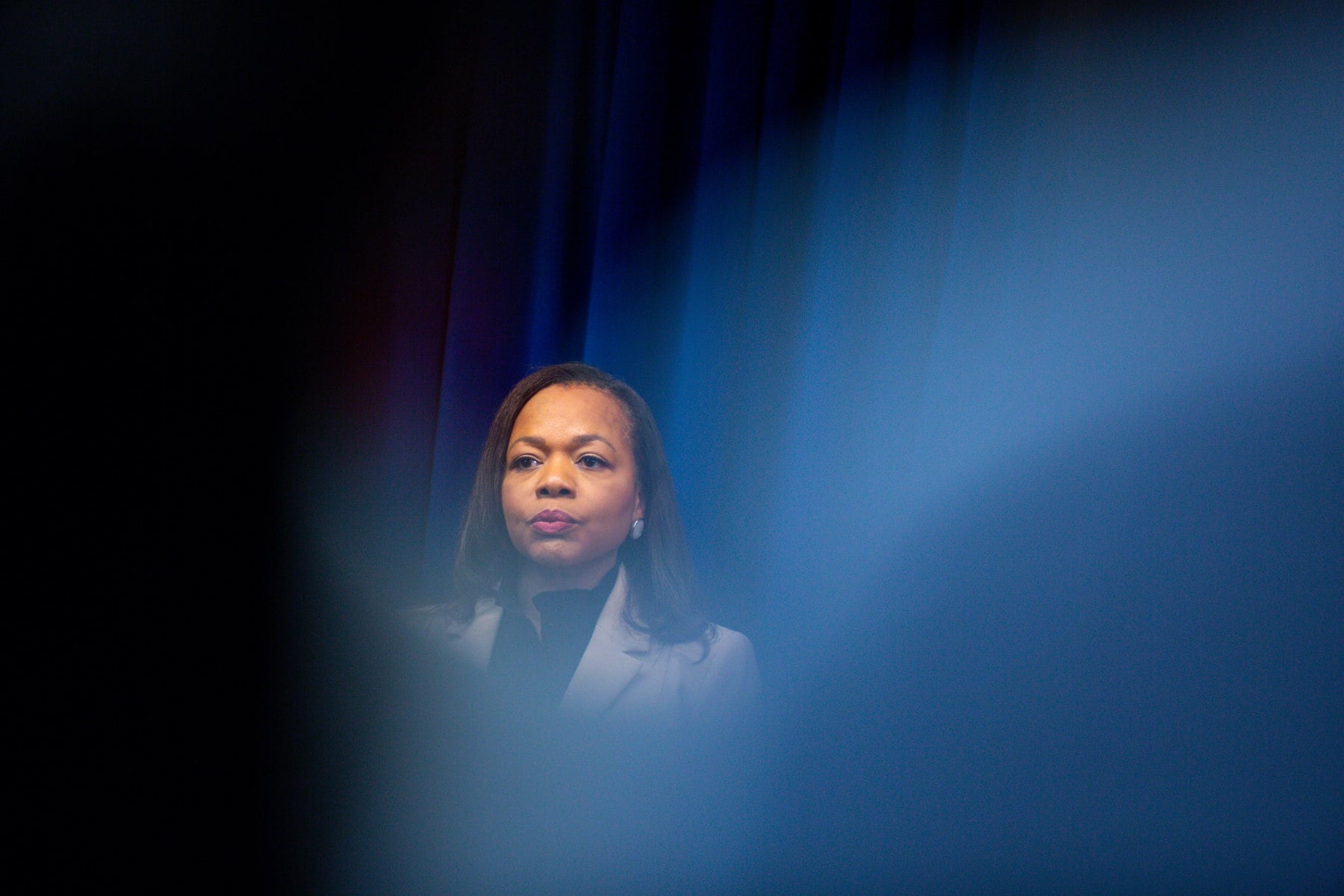
Kristen Clarke was just weeks into her job as the NAACP’s top lawyer this spring when the Supreme Court’s conservative bloc dealt what she described as the second of two “devastating blows” to the 1965 Voting Rights Act. Within hours, the NAACP held an emergency town hall to discuss the Louisiana v. Callais ruling’s impacts and outline next steps.
The first devastating blow, Clarke told The 19th in an interview last week, happened long before she joined the NAACP. In 2013, while she led the civil rights bureau of the New York state attorney general’s office, the Supreme Court decided another consequential voting rights case, Shelby County v. In the case, out of Shelby County, Alabama, the court’s conservatives invalidated a formula used to determine the parts of the country subjected to the civil rights law’s Section 5, which required areas with a history of racial discrimination to preclear changes to their voting procedures with the U.S.
Chief Justice John Roberts argued that since Congress had not meaningfully updated the formula, it had “no logical relation to the present day.” Civil rights advocates were alarmed. For nearly 50 years, Section 5’s preclearance mechanism had been a powerful tool to stop discriminatory voting practices before they were enacted. Going forward, voting changes would need to be challenged after the fact using the Voting Rights Act’s Section 2, which prohibits voting procedures and maps that discriminate on the basis of race.
Then, 13 years later, the Supreme Court took aim at Section 2 in Callais. On behalf of the court’s conservatives, Justice Samuel Alito tossed out a Louisiana voting map that had created a second majority-Black congressional district out of six in a state where about one-third of voters are Black. Section 2’s protections should only apply if voters can prove they were intentionally disenfranchised based on their race, not if a policy was seemingly neutral but had the same result, he wrote.
Callais and Shelby County v. Holder decisions has to acknowledge that our nation’s most sacred civil rights law has been hit by these devastating blows,” she continued. In both the Callais and Shelby County opinions, the conservative majority argued it was making only minor adjustments to the law that Republican former President Ronald Reagan said safeguarded the “crown jewel of American liberties” when he extended its protections.
In Callais, Alito called it an “update.” In Shelby County, Roberts, who has exhibited a decades-long hostility to the Voting Rights Act, wrote that “our country has changed” since the law was enacted. He cited as evidence data from the 2012 elections showing Black voter turnout in the six states originally covered by Section 5 had surpassed White voter turnout. At the time, liberal Justice Ruth Bader Ginsburg likened Roberts’ reasoning to “throwing away your umbrella in a rainstorm because you are not getting wet.” The consequences of the conservative majority’s approach to voting rights became clear after Shelby: Without preclearance, Black voter turnout dropped.
Extract — continue reading at the source.
/https://tf-cmsv2-smithsonianmag-media.s3.amazonaws.com/filer_public/f6/c1/f6c13729-26b0-48eb-ba8c-9404f7b2ab3f/david_seman_1983631243.jpg)