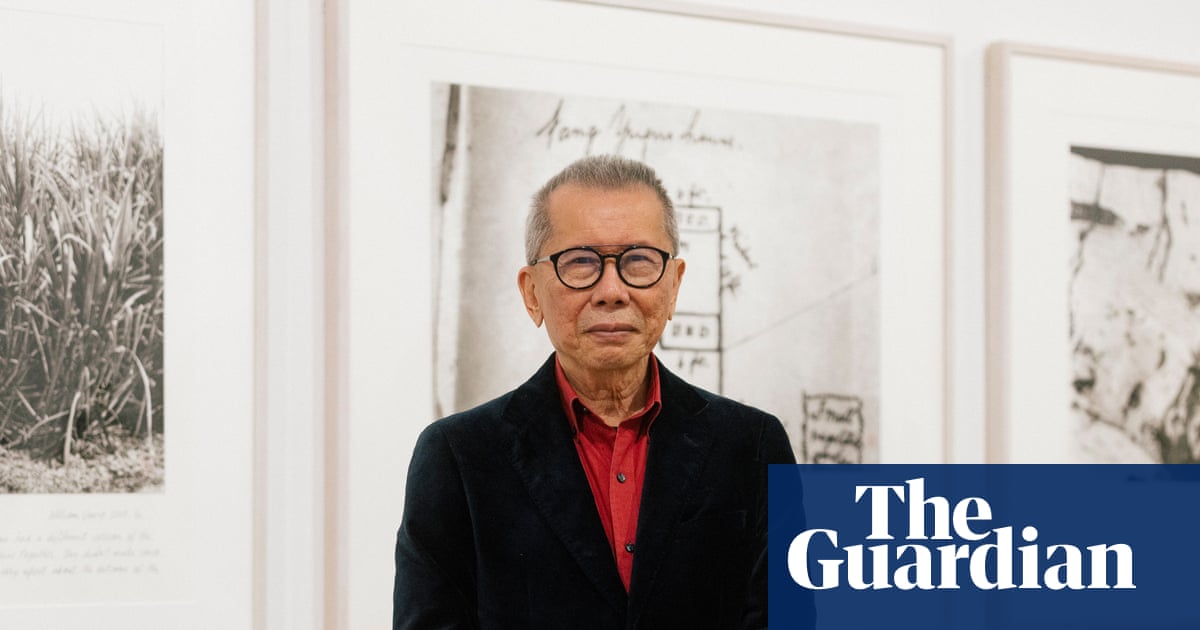
As a young adult, William Yang discovered that his family’s story was actually a murder mystery. His uncle, William Fang Yuen, was killed by an employee on the family’s farm in far north Queensland in 1922, but his mother refused to tell him the full story. In 1990, he travelled to Innisfail in search of the truth.
One aunt told Yang that his uncle and the worker had got into a fight over a gambling debt, and the worker had stabbed him to death with a spear. A cousin said a gang was involved. A local woman, who had been a child at the time, remembered it as a card game gone wrong.
Desperate for concrete evidence, Yang visited the local courthouse, where he was presented with a dusty box of documents. Inside, there were papers caked in his uncle’s blood. It turns out there was no spear, no mafia, no game of poker.
Piecing together the records, it seems Yang’s uncle had accused his employee of fiddling the farm’s accounts. They had an argument and Yang’s uncle was shot dead. The man was brought to trial, then acquitted in a decision that many believe was racist: Yang’s uncle was Chinese and his employee was white.
Seven of Yang’s trademark annotated photographs tell the story of his uncle’s death and how it traumatised his mother, who was 16 when it happened and raised Yang and his siblings to be “more Australian than the Australians.” On the final photo, of a transcript of the evidence that his mother gave during the trial, Yang has written: “I feel the legacy of this murder came down to me in that, while I was growing up, my ethnicity was suppressed.” Yang now devotes most of his time to untangling the past. He has taken between 500,000 and 1 million photographs since the late 1960s, when he first moved to Sydney. It was there that Yang came out as gay in his late 20s and became a documentarian of the city’s LGBTQ+ community, photographing individuals and events through the debauchery of the 1970s, the horror of the HIV/Aids crisis in the 1980s and 1990s, the growing acceptance and subsequent journey to gay marriage in 2017.
Alongside these are photos documenting how Yang came to embrace his Chinese heritage – he says he “came out as Chinese” in his mid 30s – as well as his portraits of Australian cultural luminaries such as the writers Patrick White and Barbara Blackman; artists such as Brett Whiteley and Max Dupain; and actors like Cate Blanchett and Sam Neill. The State Library of New South Wales has acquired about 50,000 of Yang’s negatives from the 1970s and is now negotiating with the photographer over his images from the 1980s and 1990s, which he is busy digitising. The process has given him new insights into his own work.
Extract — continue reading at the source.