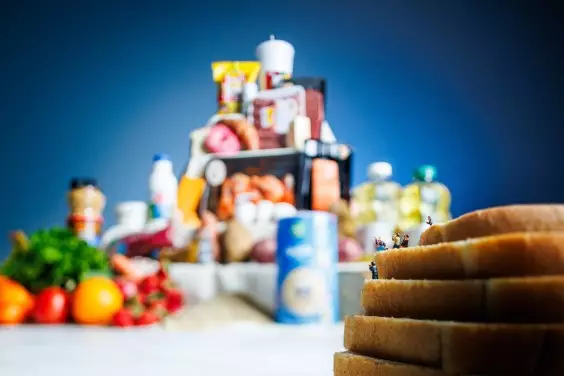
Our country has a long and tortured history with food pyramids. The original dietary schematic, unveiled in 1992, had a firm foundation of carbohydrates—the bread, cereals, rice, and pasta group. It may seem unimaginable now, but the federal government recommended getting a whopping 6 to 11 servings of these every day.
Of course, those guidelines were dramatically revamped in 2011 when USDA officials ditched the pyramid shape altogether in favor of a simpler (and frankly more appropriate) plate design emphasizing grains, vegetables, and fruits and minimizing dairy. Then Health and Human Services Secretary Robert F. Kennedy Jr. came along, scrapped the plate, and inexplicably turned the pyramid upside down.
His new inverted food pyramid has a base (on the top) consisting of protein, dairy, fats, vegetables, and fruit with an apex (on the bottom) made of whole grains. The two-front war on proteins and saturated fats was over, Kennedy declared, but a new war on sugar has begun. Now there’s a new food pyramid, and this one is at least backed up by some research.
After comparing national and regional dietary guidelines from several countries around the world and surveying studies from more than 250 publications, an international team of nutritional scientists recently published their own pyramid-shaped dietary guidelines. The guide, which promotes a plant-forward omnivorous diet, also draws inspiration from the EAT-Lancet Planetary Health Diet, a project to reshape global eating patterns to be healthier for the planet, as well. Red meat, butter, refined grains, and sugary drinks are at the top, and should only be eaten sparingly.
Vegetables and fruits are on the bottom, alongside whole grains and those with a low glycemic index (GI), which take longer to digest and don’t spike your blood sugar. Beans, peas, lentils, fish, and poultry should take priority over either red or processed meats, and plant-based foods should make up the bulk of any meal. Canola or olive oil is best for cooking (compared to animal fats like butter or beef tallow), and whole grains are better than refined ones.
If you’re snacking, opt for nuts, seeds, and fruits, or veggies with hummus. Finally (and obviously), skip sugary soft drinks in favor of water or sugar-free beverages. Read more: “Confessions of a Reluctant Protein-Maxxer” Obviously, making these healthy choices is easier said than done, especially in the United States (home of inexpensive fast food, ultraprocessed snacks, and a steady stream of ads featuring both).
Extract — continue reading at the source.