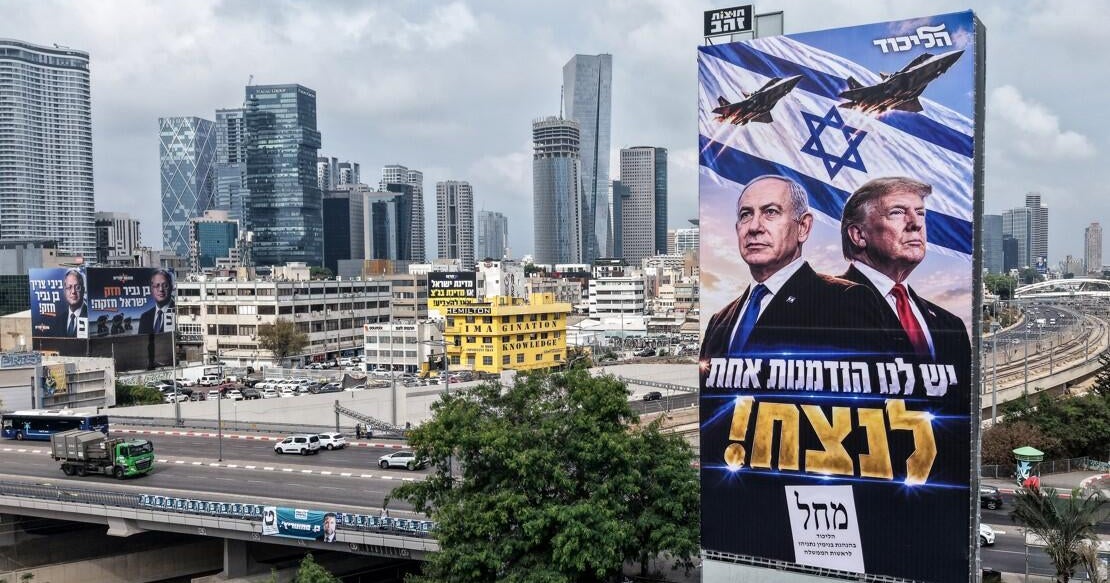
Tel Aviv — After three years with their country at war on multiple fronts, Israelis will go to the polls Tuesday in a hotly contested election that will shape their next government. Polls show it is an incredibly tight race, and as Prime Minister Benjamin Netanyahu fights to hold onto his job, there's no guarantee of a quick, definitive outcome for him or his political opponents. Polls vary widely regarding the expected outcome.
Right-leaning pollsters give an advantage to the right-wing and religious bloc led by Netanyahu, while left-leaning pollsters show an advantage for the so-called change bloc opposing the incumbent. Most polls show neither side is likely to win a decisive majority of the 120 seats in Israel's parliament, the Knesset, which would enable it to unilaterally form a new government. The tight margins mean the voting may end in a stalemate, which could lead to protracted negotiations across ideological lines, the formation of a minority government, or even an election do-over.
"It looks like an indecisive outcome is the most likely outcome," said Yohanan Plesner, president of the Israel Democracy Institute. This will be the first election since the Oct. 7, 2023, attacks by Hamas, which authorities have acknowledged as Israel's most catastrophic security failure since the country's founding in 1948. Israelis will go to the polls Tuesday with their country still — fighting in the subsequent multi-front war in Gaza, Lebanon and Syria, and after two direct rounds of conflict with Iran and Netanyahu advocating for a third.
Against that backdrop, there are a few key issues that could determine the election outcome, even if it does take days or weeks to shake out. But first, here's a look at the two main factions vying for the votes. Netanyahu, Israel's longest serving prime minister and leader of the Likud party, is seeking to form another coalition similar to his current government, which relies on partnerships with ultranationalist and Jewish religious parties.
He has two main pitches to voters: First, that only he can form a government without the support of Israel's Arab parties, which he argues would be a danger to the country if they gain enough seats to influence Israel's engagement in its myriad conflicts. Netanyahu's second argument to voters is that Israel's campaigns in Gaza, Lebanon, and especially Iran, are ongoing, and he needs more time to finish what his government started. President Trump offered a full-throated endorsement of Netanyahu last week.
He reiterated his administration's firm support for the war the two men launched jointly against Iran almost eight months ago, and warned that he could be disinclined to continue with it if Netanyahu doesn't hold onto power. "If Israel has the wrong Leader, which would be anyone other than Bibi, America will have to do this work ourselves, and I am not inclined to do so," Mr. Since that endorsement, Netanyahu has argued that only he can work with Mr.
Extract — continue reading at the source.